Quick Facts
- Project Name: IF Architecture Collingwood Studio
- Total Area: 100 square meters
- Design Philosophy: The "Living Laboratory" – a real-time testing ground for spatial and material innovation.
- Key Efficiency: Achieves the workflow capacity of a traditional 200sqm office while reducing operational footprint by 22%.
- Materials: Perforated galvanized steel, cork joinery, velvet textiles, and organic timber.
In the rapidly evolving landscape of interior design, the traditional office is no longer just a place to sit; it is becoming an incubator for ideas. Nowhere is this more evident than in IF Architecture’s Collingwood Studio. At just 100 square metres, this space defies the conventional limitations of a small footprint. It functions as a Living Laboratory, a term we use in modern workspace design to describe an experimental environment that serves as a real-time testing ground for architectural concepts. Here, designers aren't just drafting plans; they are living within them, allowing daily operations to refine spatial strategies and material choices before they are ever applied to a client’s project.
The Concept of a 'Living Laboratory'
The shift toward a "Living Laboratory" model represents a fundamental change in how design firms operate. Instead of viewing a studio as a static showroom, IF Architecture treats its Collingwood base as a dynamic feedback loop. This approach is more than an aesthetic choice; it is a strategic business move. Research indicates that the integration of living laboratory feedback loops in design studios can accelerate the prototype-to-project realization cycle by up to 40% compared to conventional firm structures.
By testing how light hits a certain grade of perforated metal or how a specific furniture layout encourages spontaneous collaboration, the firm can provide clients with data-backed recommendations rather than just stylistic opinions. A prime example of this refinement process is the studio’s ongoing collaboration with Baker Bleu. The studio serves as a physical case study where the intersection of retail, hospitality, and workspace is tested and tweaked, ensuring that the final commercial output is as functional as it is beautiful.
Maximizing Functionality: The Art of 'Double-Duty' Elements
The greatest challenge of a 100sqm office is the threat of clutter and the feeling of confinement. To combat this, IF Architecture employs "double-duty" elements—pieces of architecture that serve multiple purposes simultaneously.
How can a 100sqm office maximize functionality? Small workspaces maximize utility by employing elements that offer directional orientation and flexible zoning. In the Collingwood studio, the traditional rigid wall is replaced by fluid transitions.
The Central Meeting Zone
In place of fixed plasterboard walls, the studio utilizes double-sided, vibrant velvet curtains. These curtains do more than just manage acoustics; they act as soft architecture. When drawn, they create a private, intimate pod for client presentations. When opened, they vanish, integrating the meeting area back into the main workflow. This flexibility allows a compact space to pivot from a high-focus environment to a social event space in seconds.
Directional Design: The Teardrop Strategy
Furniture choice is another critical component of spatial maximization. The studio features a bespoke teardrop-shaped table. Unlike a standard rectangle, the teardrop shape removes "head of the table" hierarchies and creates natural circulation paths. It guides the eye and the body through the space, making the 100sqm floor plan feel intuitive and expansive rather than obstructed.

Materiality and Biophilia: Creating a Performance-Enhancing Environment
The material palette in the Collingwood studio is a masterclass in what I like to call "utilitarian familiarity." It balances the raw, industrial bones of the building with materials that feel deeply human and tactile.
Why are natural materials like cork and timber used in modern studios? Materials like cork and timber are essential for introducing verticality and warmth to industrial spaces. Beyond their beauty, they offer biophilic benefits—reducing stress and increasing cognitive function—while providing practical surfaces for collaboration, such as pin-up walls for mood boards.
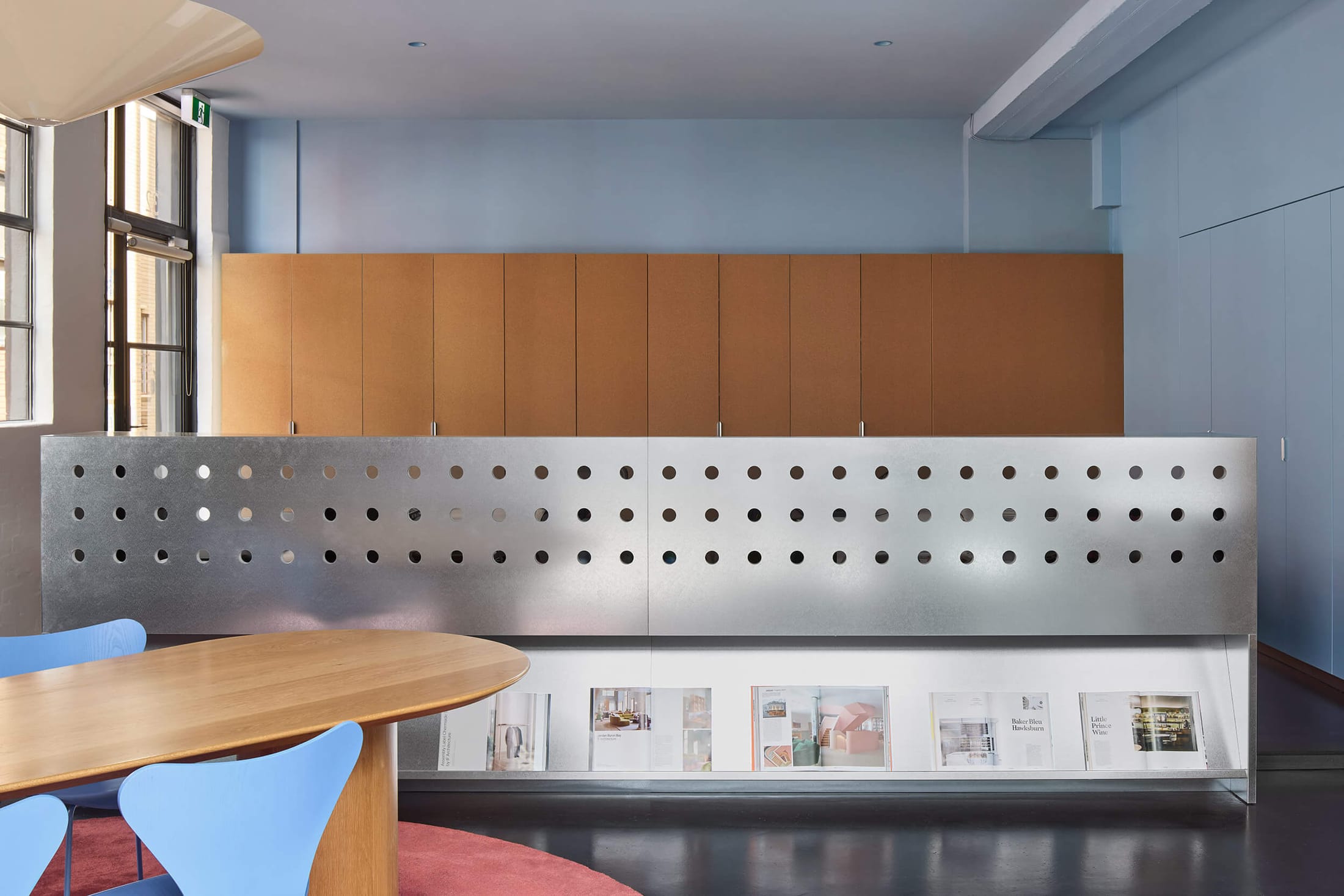
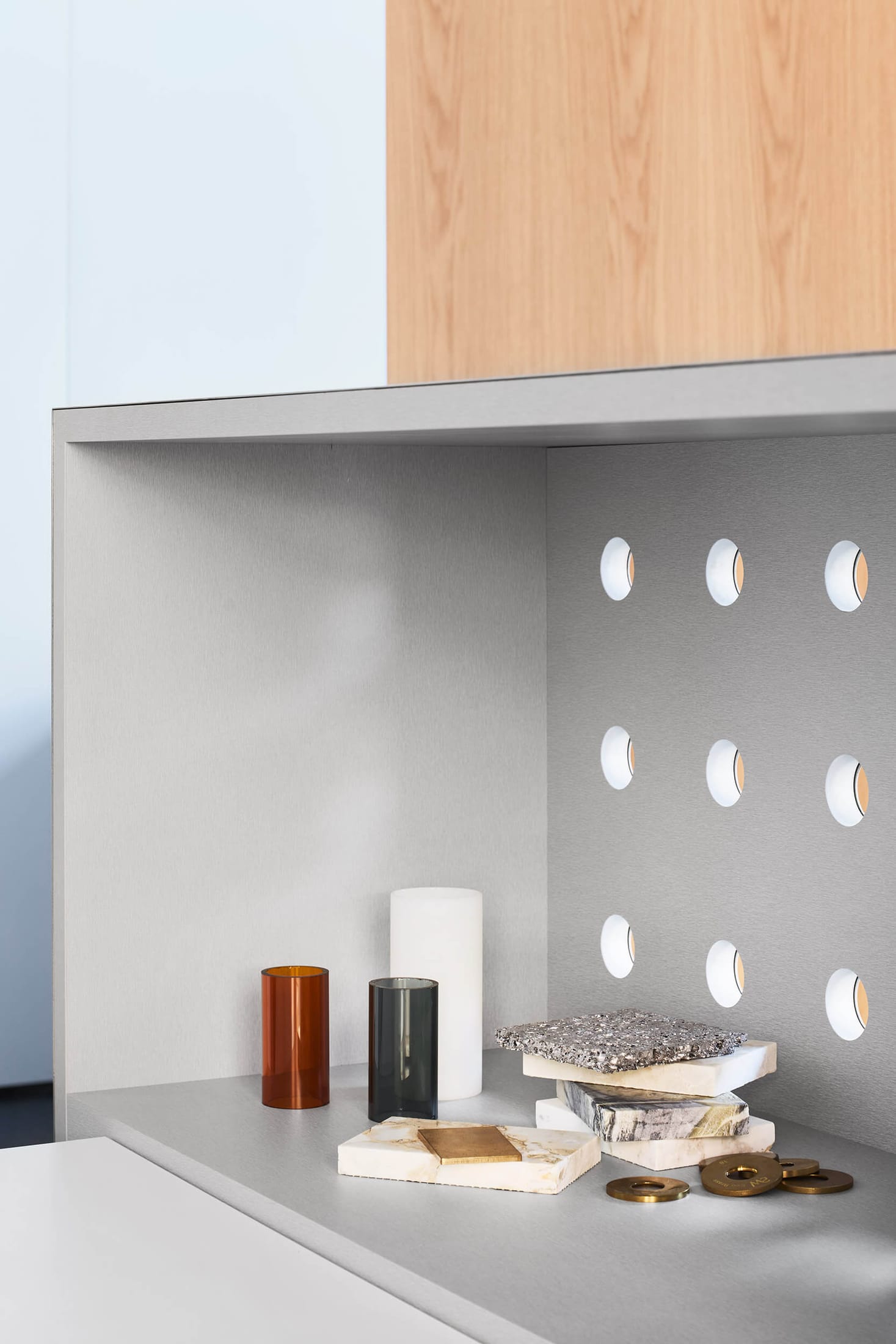
- Galvanized Steel: Perforated metal partitions provide a sense of "privacy without isolation." They allow light to filter through the studio, maintaining a visual connection between team members while defining distinct work zones.
- Cork Joinery: Used extensively for storage and wall surfaces, cork is naturally antimicrobial and provides excellent acoustic dampening. Its texture invites touch, grounding the high-tech design in a natural element.
- Soft Blue Hues and Tanned Leather: These colors and textures balance the "cool" feel of the steel. The use of tanned leather for seating adds a layer of residential comfort, signaling that the workplace is a place for living as much as it is for working.

The Kitchen Reimagined: Social Architecture
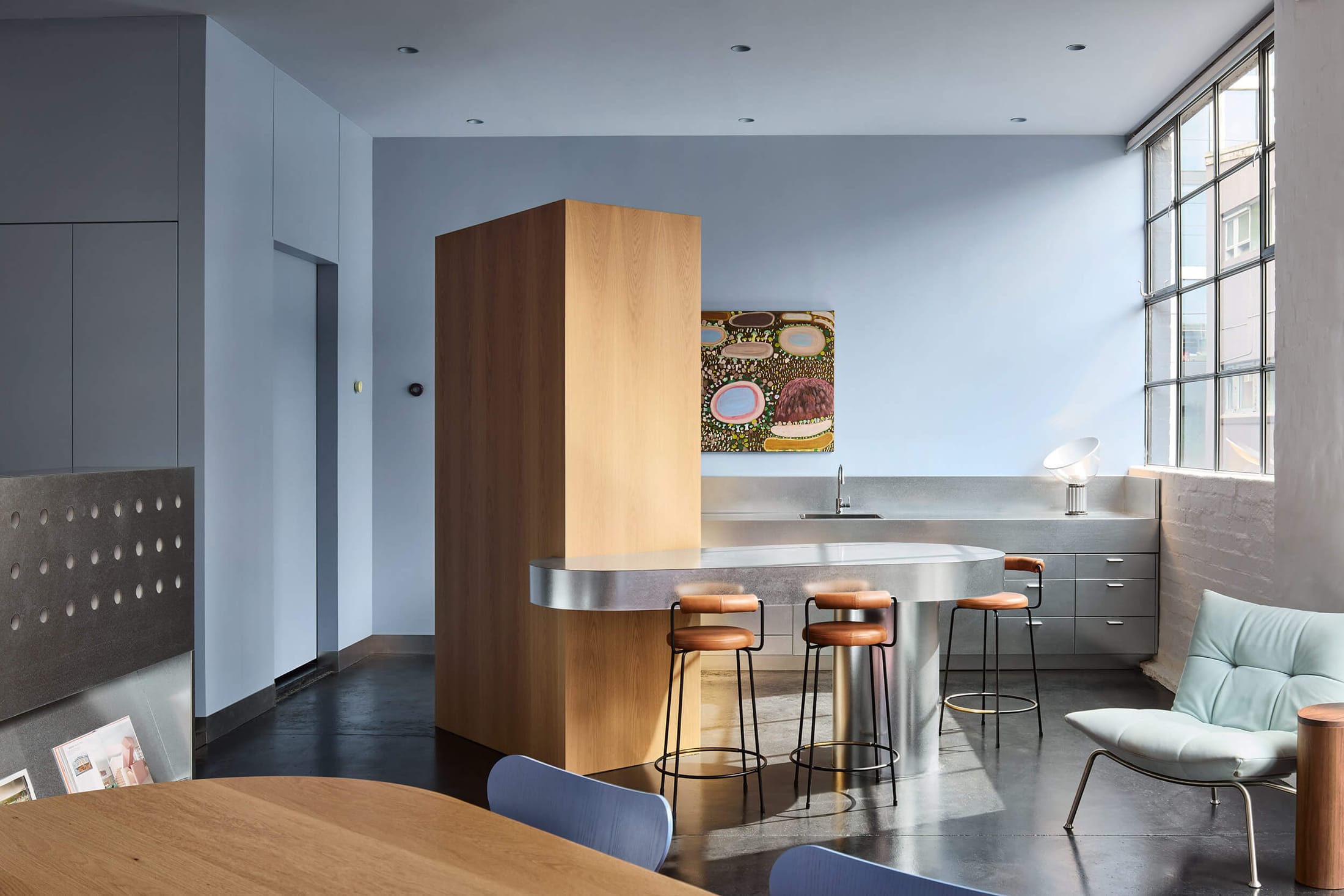
In a small studio, the kitchen cannot afford to be just a kitchen. At IF Architecture, it is reimagined as a secondary meeting hub. By using stand-alone volumes and organic steel finishes, the kitchen becomes a focal point of the studio's "social architecture."
The use of industrial metallic surfaces ensures durability, but the placement of the island allows it to function as a standing desk, a layout space for large-format drawings, or a gathering spot for Friday afternoon debriefs. This multifunctional spatial strategy is a key reason why studios under 120sqm can reduce operational footprint overhead by up to 22% while maintaining the workflow capacity of a traditional 200sqm office.
Modern Workplace Strategy 2026: Trends for Success
Looking toward 2026, the Collingwood studio exemplifies several burgeoning trends in workplace design. The focus is shifting from "modular furniture" to "operational flexibility."
- Precision Adaptability: Every piece of joinery in the studio acts as both storage and a tactile library. This allows for a clean-desk policy that doesn't sacrifice access to physical research materials.
- Designing for Neurodiversity: Modern workplaces are increasingly catering to neurodiverse workforces—estimated to be up to 25% in creative fields. By providing varied zones—from the open collaboration of the teardrop table to the acoustic softness of the curtained pods—IF Architecture ensures a productive environment for everyone.
- Sustainable Procurement: Sustainability is woven into the studio's DNA through the use of FSC-certified timber and a circular economy mindset. Materials are chosen for their longevity and their ability to be recycled or repurposed if the studio ever needs to move.
Future-Proofing: Digital and AI Integration
While the physical environment is tactile and grounded, the "Living Laboratory" is also future-proofed for the digital age. The studio integrates smart infrastructure that remains largely invisible to the eye.
- Invisible Technology: A frictionless, cable-free environment is achieved through integrated power points within the cork joinery and under-floor routing. This allows the team to move laptops and tablets freely without the "visual noise" of tangled cords.
- AI-Driven Environmental Controls: As we move closer to 2026, the studio is testing IoT-enabled monitoring to optimize lighting and temperature based on real-time occupancy. This not only reduces energy costs but ensures the environment is always at peak performance levels for the occupants.
Conclusion: The New Standard for High-Performance Workspaces
The IF Architecture Collingwood Studio proves that "small" does not mean "limited." By embracing the philosophy of the Living Laboratory, the firm has created a space that is resilient, human-centered, and incredibly efficient. It serves as a reminder that good design isn't about how much space you have, but how hard you make that space work for you.
For designers and business owners alike, the takeaway is clear: flexibility is no longer just an aesthetic choice; it is an operational necessity. As we look toward the future of work, the "Living Laboratory" model offers a blueprint for how we can create environments that learn, adapt, and grow alongside us.
FAQ
1. What is the most important element in a small office design? The most important element is "multi-functionality." Every piece of furniture or architectural feature should serve at least two purposes—for example, storage that doubles as an acoustic barrier or a kitchen island that functions as a meeting table.
2. How do curtains improve a workspace compared to glass walls? While glass provides visual transparency, it often creates acoustic issues and lacks flexibility. Curtains offer "soft architecture," providing immediate acoustic dampening and the ability to physically open or close a space in seconds, which is essential for 100sqm layouts.
3. Is the "Living Laboratory" concept expensive to implement? While the initial bespoke joinery (like cork or steel partitions) may have a higher upfront cost, the strategy reduces long-term overhead. By maximizing a smaller footprint (100sqm vs. 200sqm), businesses can save significantly on rent and utilities, often seeing a return on investment within the first two years.