Quick Facts
- Designers: Philip Johnson (Architect) and Richard Kelly (Lighting Pioneer)
- Original Debut: 1953, specifically for the Glass House and the Hodgson House.
- Core Innovation: Designed to eliminate glare and window reflections in glass-walled architecture.
- Lighting Philosophy: Utilizes Richard Kelly’s "Focal Glow" concept to create intimate pools of light.
- 2025 Reissue Manufacturer: BassamFellows, in partnership with The Glass House and the National Trust for Historic Preservation.
- Key Specs: 41 inches tall, 25-inch shade diameter, 30W dimmable LED.
- Finishes: Natural Stainless Steel, Blackened Stainless Steel, Bronze, and Satin Brass.
The Architecture of a Lighting Crisis
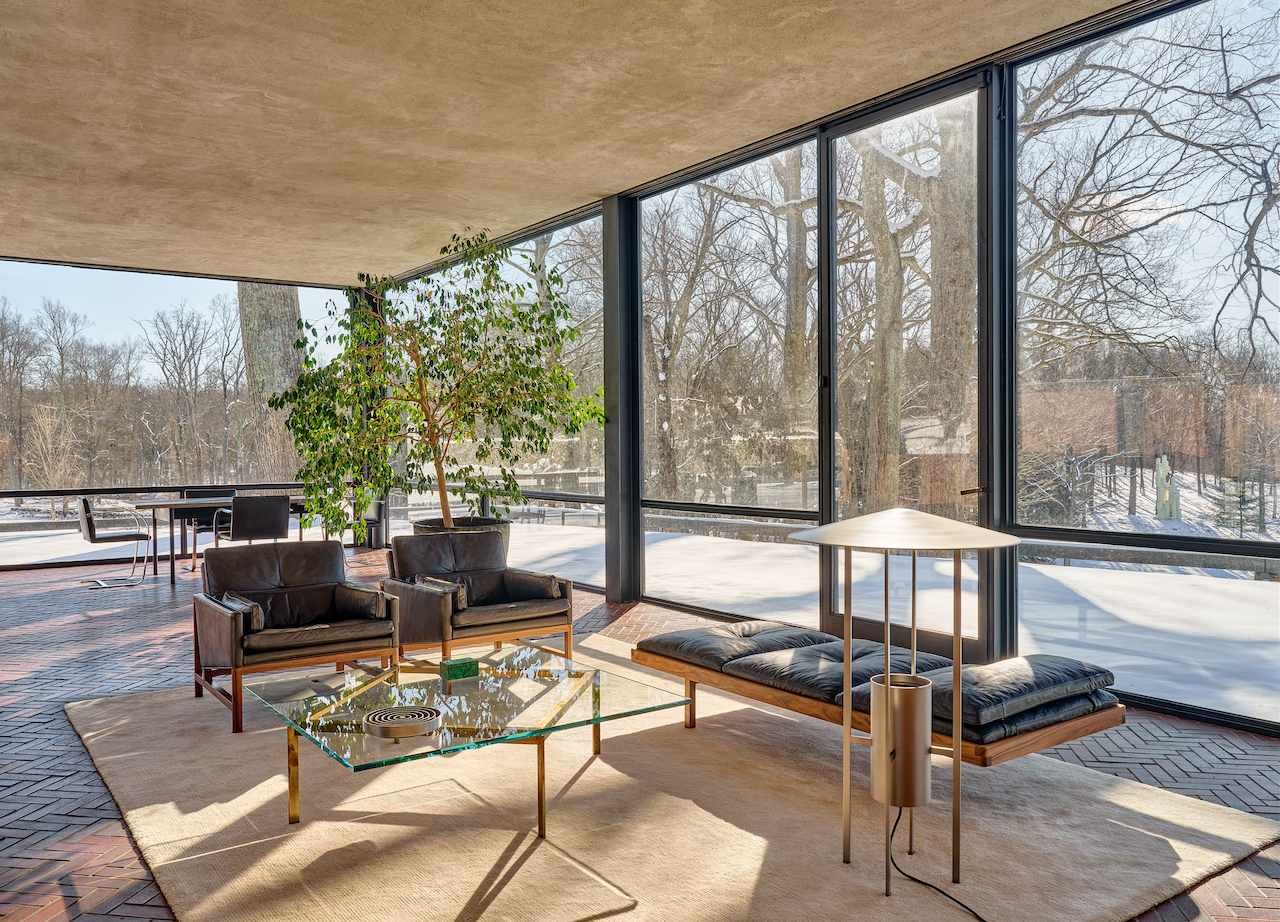
In 1949, when Philip Johnson completed his iconic Glass House in New Canaan, Connecticut, he famously declared that he had "the best wallpaper in the world"—the surrounding forest. However, as the sun set on his transparent masterpiece, a fundamental architectural crisis emerged. In a home where the walls are made entirely of glass, traditional interior lighting turns the environment into a hall of mirrors.
Standard lamps, with their shades positioned at eye level, created what Johnson called the "six-bulb reflection" problem. Instead of looking out into the moonlit woods, inhabitants were staring at a chaotic grid of light bulbs reflected infinitely against the dark glass. The very transparency that defined the house disappeared at night, replaced by a blinding, domestic glare.
The 1953 Glass House Floor Lamp was co-designed by Philip Johnson and lighting pioneer Richard Kelly specifically to solve this. Their mission was to eliminate glare and reflections in glass-walled residential spaces, allowing the architecture to breathe even after dark. By rethinking the height and direction of light, they created a piece that didn't just illuminate a room; it preserved the relationship between the interior and the landscape.
Richard Kelly and the Art of 'Focal Glow'
While Philip Johnson provided the architectural canvas, Richard Kelly provided the soul of the light. Often cited as the father of modern lighting design, Kelly transitioned from the world of stage lighting to become a residential guru for the mid-century elite. He understood that light wasn't just about visibility; it was about emotion and focus.
Kelly famously categorized light into three functional elements: Ambient Luminescence (the overall glow), Play of Brilliants (the sparkle of a chandelier or sunlight on water), and, most importantly for this lamp, Focal Glow.
"Focal glow is the follow spot on the modern stage. It is the pool of light at your favorite reading chair... it draws the eye, commands attention, and separates the important from the unimportant." — Richard Kelly
To achieve this "Focal Glow" in the Glass House, Kelly and Johnson looked downward. They realized that by positioning the light source low to the ground and reflecting it downward via a massive, wide-brimmed conical shade, they could provide ambient warmth without the harshness of an exposed bulb. At 41 inches tall, the lamp sits below the horizon line of a seated person. The light stays on the floor and the furniture, leaving the glass walls dark and clear to the outside world.
The BassamFellows Reissue: A Faithful Return
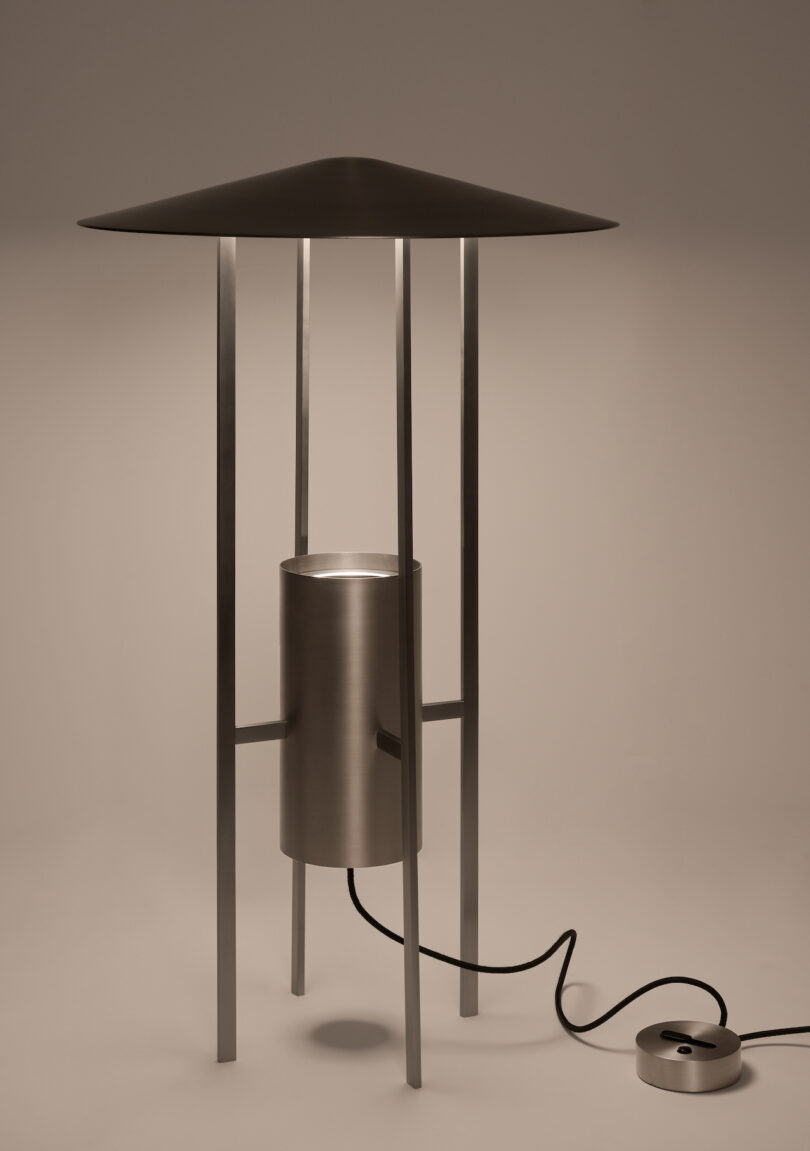
For decades, the 1953 Glass House Floor Lamp remained a "lost" icon, seen only in archival photographs or within the preserved rooms of Johnson’s own estate. That changes with the official reissue by BassamFellows. Known for their "Craftman Modern" aesthetic, BassamFellows has positioned themselves as the ultimate custodians of this design history, working in direct partnership with The Glass House and the National Trust for Historic Preservation.
This wasn't a simple case of copying a shape. The team at BassamFellows embarked on an archival journey, studying original specimens from the Hodgson residence (another Johnson-Kelly collaboration) to ensure every curve of the hand-spun shade was historically accurate.
The result is a piece that feels remarkably heavy and substantial—a "functional sculpture" that bridges the gap between furniture and lighting. BassamFellows is the official manufacturer of the 1953 Floor Lamp reissue, and they have expanded the original vision to include four distinct finishes: Natural Stainless Steel, Blackened Stainless Steel, Bronze, and Satin Brass.
Technical Craftsmanship & Modern Updates
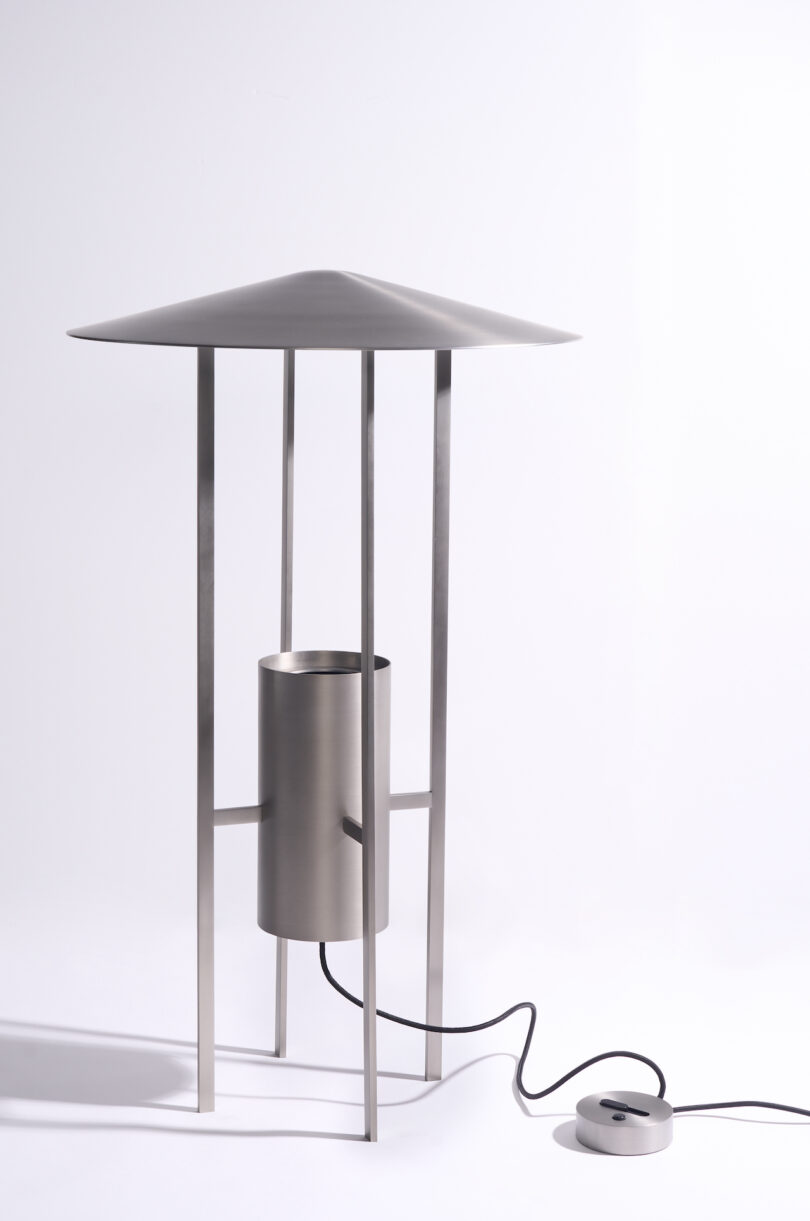
While the silhouette remains identical to the 1953 original, the internal soul of the lamp has been modernized for the 21st century. The 2025 reissue maintains historical accuracy with a standing height of 41 inches and a shade diameter of 25 inches, but it swaps the original incandescent heat for a high-performance 30W LED system.
The materiality is where the BassamFellows touch is most evident. The shades are hand-spun from stainless steel, a process that requires immense skill to achieve a perfectly smooth, conical taper. The finishes are applied using a vacuum-plating process, ensuring that the Satin Brass and Bronze options have a depth and luster that won't flake or fade over time.
| Feature | 1953 Original Specification | 2025 BassamFellows Reissue |
|---|---|---|
| Height | 41 Inches | 41 Inches (Historical Accuracy) |
| Shade Diameter | 25 Inches | 25 Inches (Hand-spun) |
| Light Source | Incandescent Bulb | 30W High-Performance LED |
| Control | Standard Switch | Integrated Driver & Full-Range Dimmer |
| Finishes | Primarily Stainless | Natural, Blackened, Bronze, Satin Brass |
| Sustainability | Low efficiency | Energy Star Rated Components |
The addition of an integrated dimmer is perhaps the most significant functional update. It allows the user to fine-tune the "Focal Glow," moving from a bright, concentrated task light for reading to a whisper-thin ambient glow that barely registers on the surrounding glass.
Styling the 1953 Lamp in the Modern Home
Why does a 70-year-old lamp feel so relevant today? As our homes increasingly feature open-plan living and floor-to-ceiling windows—even in urban apartment settings—the "lighting crisis" Philip Johnson faced has become a common modern reality.
The Low-Profile Advantage
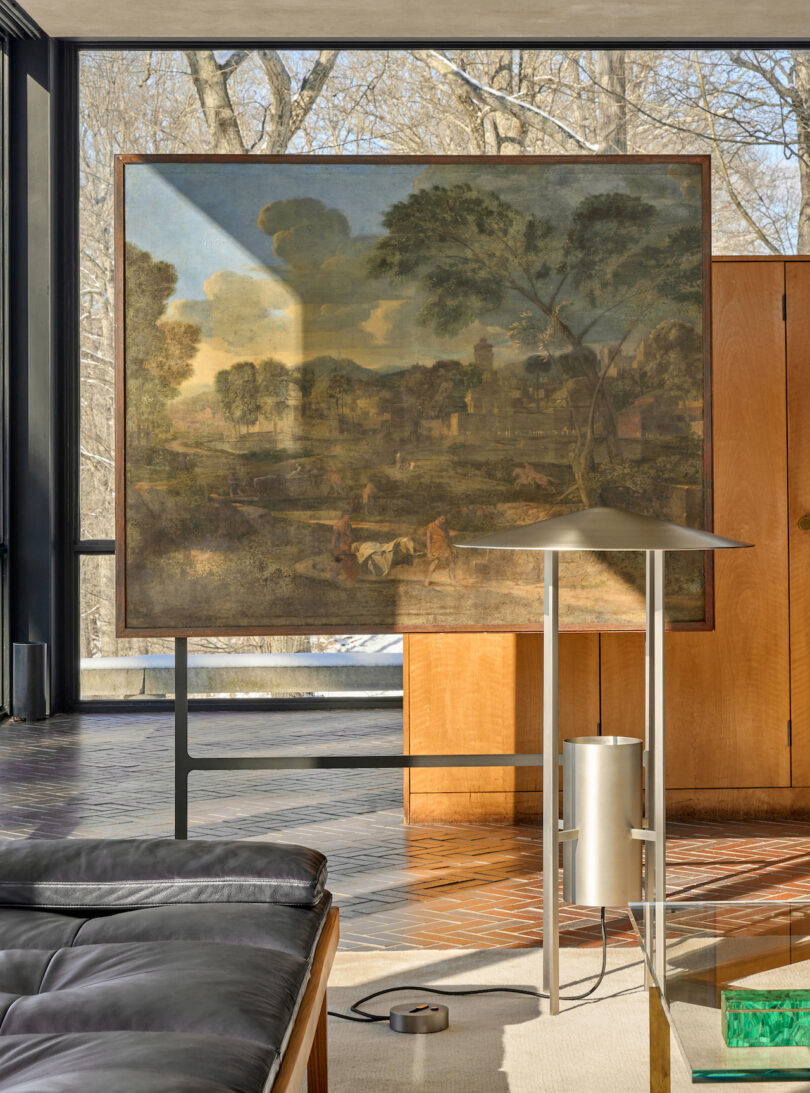
Unlike the towering Arco lamp or the airy Noguchi lanterns, the 1953 Glass House Lamp is purposefully "grounded." When styling this in a room, think of it as an anchor. It pairs beautifully with low-slung, mid-century sofas like the Knoll Florence or the Eames Lounge Chair. Because it stays below the sightline, it doesn't break the visual flow of a room, making it ideal for minimalist spaces.
Creating Pools of Intimacy
In large, open-concept lofts, light can often feel "lost" or cavernous. Using this lamp creates what designers call a "pool of light." By reflecting everything downward, it creates a psychological zone of privacy. Place it in a reading nook or between two lounge chairs to define a conversation area without the need for physical dividers.
Materiality and Contrast
If your space is dominated by warm woods and soft textiles, the Blackened Stainless Steel or Natural Stainless finish provides a sharp, industrial counterpoint. For those leaning into the "Quiet Luxury" or "Warm Minimalism" trends, the Satin Brass offers a soft, gold-toned reflection that complements travertine and bouclé fabrics.
FAQ
Q: Is the light output sufficient to illuminate a whole room? A: No, and that is intentional. This lamp is designed for "Focal Glow"—to illuminate the floor and the immediate area. It is best used as part of a layered lighting scheme, providing intimacy while other sources provide general ambient light.
Q: Does the shade get hot with the 30W LED? A: Unlike the original incandescent versions which could become quite warm, the modern LED reissue features an integrated driver that manages heat efficiently. The hand-spun steel shade remains cool to the touch.
Q: Can this lamp be used in smaller apartments? A: Absolutely. While it was designed for the sprawling Glass House, its 41-inch height makes it an excellent choice for smaller spaces where a standard floor lamp might feel too imposing or tall.
The Verdict
The reissue of the 1953 Glass House Floor Lamp is more than just a nostalgia trip; it’s the return of a sophisticated solution to a very modern problem. In an age of glass and steel, Philip Johnson and Richard Kelly’s "Focal Glow" reminds us that the best design isn't about what we see, but how we see the world around us. Whether you are a mid-century purist or a modern minimalist, this lamp remains a masterclass in functional art.