Can raw industrial minimalism and unrestrained maximalist expression truly coexist? It is a polarizing question that typically divides the design world into two camps: those who crave the silence of negative space and those who find joy in a riot of color and texture. However, in the heart of Warsaw’s burgeoning Praga district, Mistovia Studio has delivered a resounding "yes" to this architectural riddle. Their latest project—a 75-square-metre structural overhaul—serves as a masterclass in the 'minimalist-maximalist' aesthetic. By stripping a cramped apartment down to its bare bones and layering it with vibrant burl veneers, blue quartzite, and 20th-century vintage icons, they have created a home that feels both industrially raw and decadently curated.
Quick Facts: The Praga Overhaul
- Location: Praga District, Warsaw, Poland
- Designer: Mistovia Studio
- Size: 75 Square Metres
- Structural Scope: Removal of 90% of interior partition walls
- Key Materials: Exposed concrete, walnut burl wood, glass blocks, blue quartzite, Rosso Francia terracotta
- Design Language: Minimalist-Maximalist / Industrial Chic meets Mid-century Modern
The Praga district itself provides the perfect backdrop for such a daring project. Once an industrial hub, it has transformed into Warsaw’s "coolest" neighborhood, attracting fashion-forward homeowners and savvy investors alike. This shift is mirrored in the real estate market; Warsaw currently ranks 12th among 32 major European cities for investment and development prospects in the 2026 Emerging Trends in Real Estate report. For the owners of this apartment, the goal wasn't just a renovation—it was an artistic statement that capitalized on the district's rising prestige.
The Structural Challenge: From Cramped to Concept
The primary hurdle of the project was the original floor plan. Like many mid-20th-century apartments, the space was a labyrinth of small, dark rooms and restrictive partition walls. To achieve the sense of airy luxury desired by the clients, the structural overhaul involved the removal of nearly 90% of the original interior walls. The goal was to transition from a claustrophobic room configuration to a 75sqm open-concept layout that maximized natural light from the large windows.
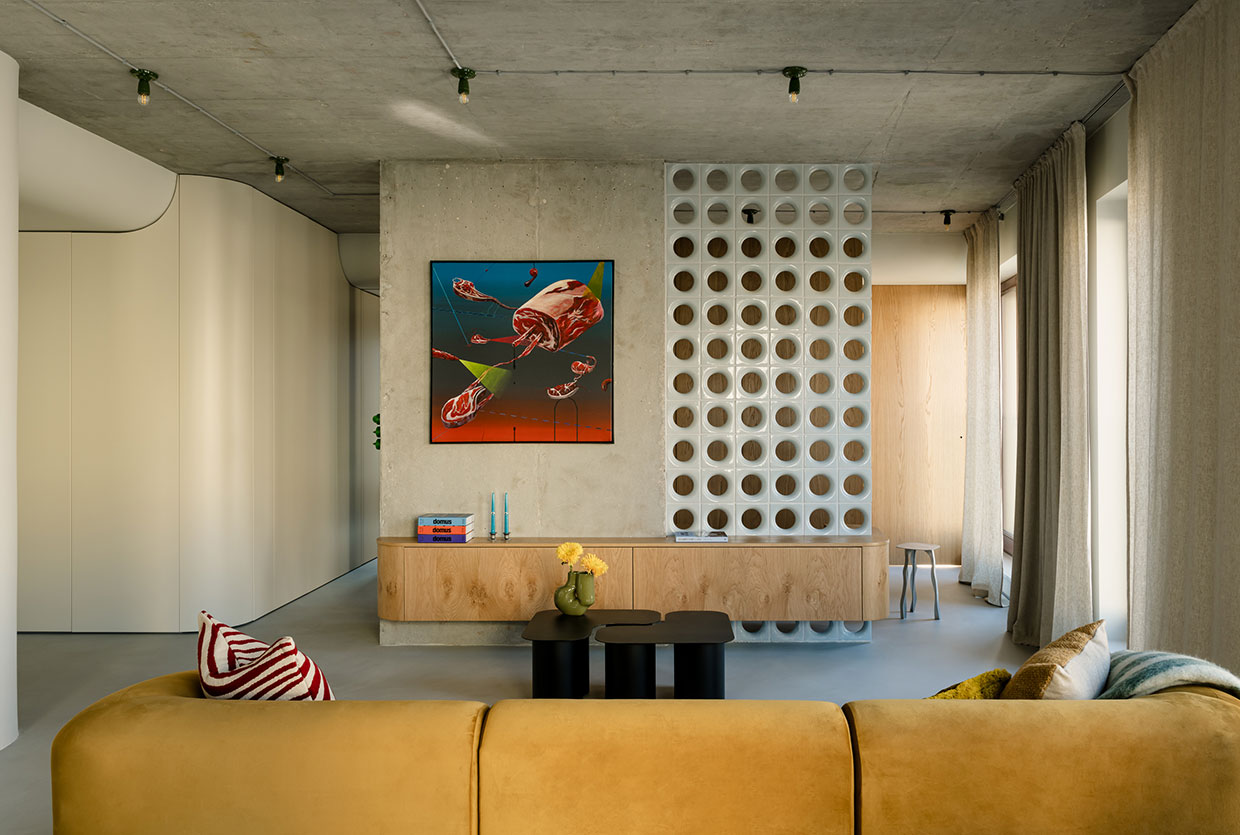
However, the demolition revealed a permanent obstacle: a massive, unmovable reinforced concrete column standing defiantly in the center of what was to be the living area. Rather than attempting to conceal it behind drywall or cabinetry, Mistovia Studio leaned into the philosophy of lead designer Marcin Czopek: "If you can’t hide it, highlight it."
The team transformed the column into a sculptural focal point. They extended its presence by pairing it with a semi-translucent glass block wall, which divides the entrance from the living zone without sacrificing light. To anchor the structure further, custom artwork by Zbigniew Olszyna was integrated, turning a structural necessity into a gallery-worthy installation. The result is a fluid living space where the raw history of the building remains visible, yet refined.
The Aesthetic Narrative: A Minimalist-Maximalist Ethos
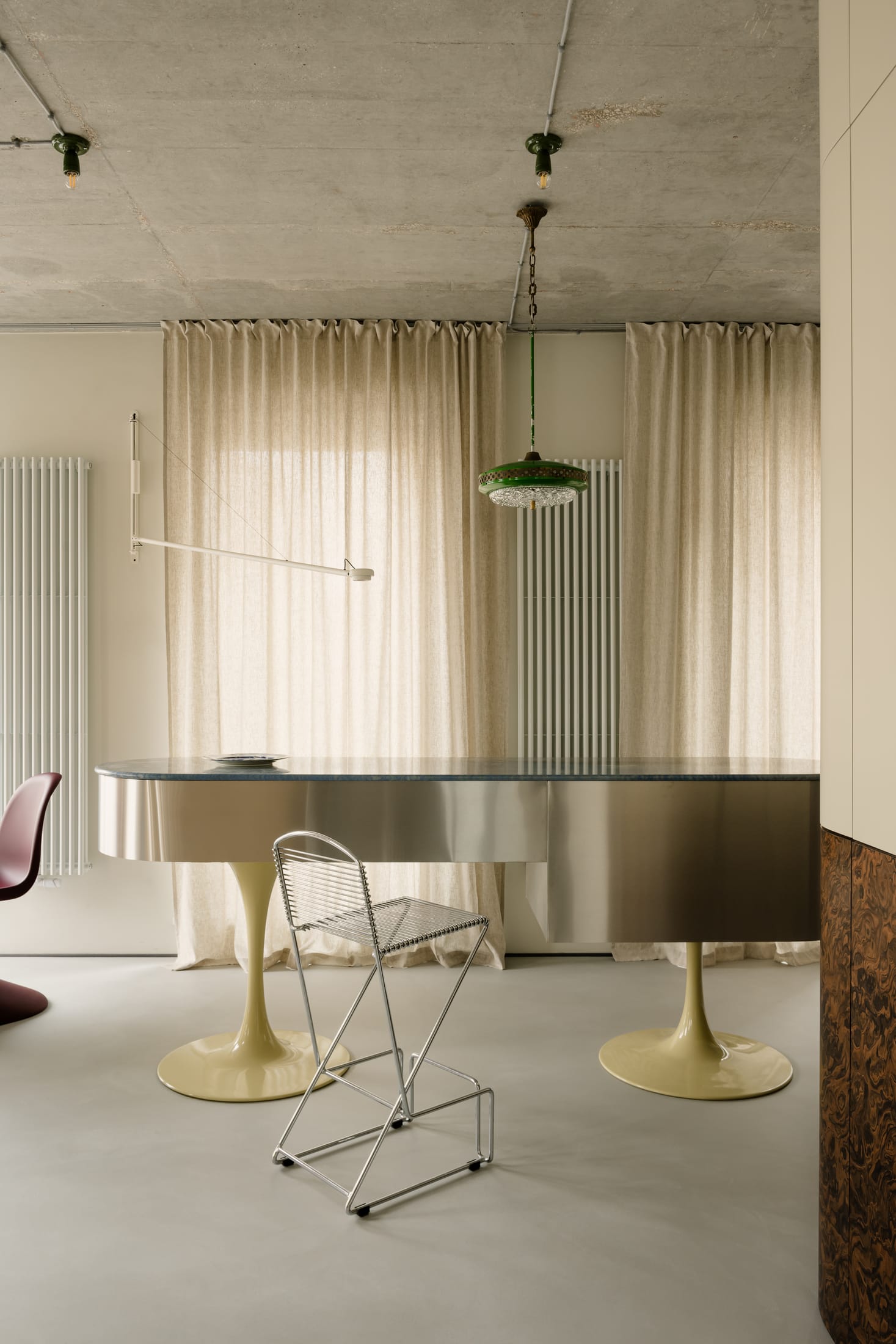
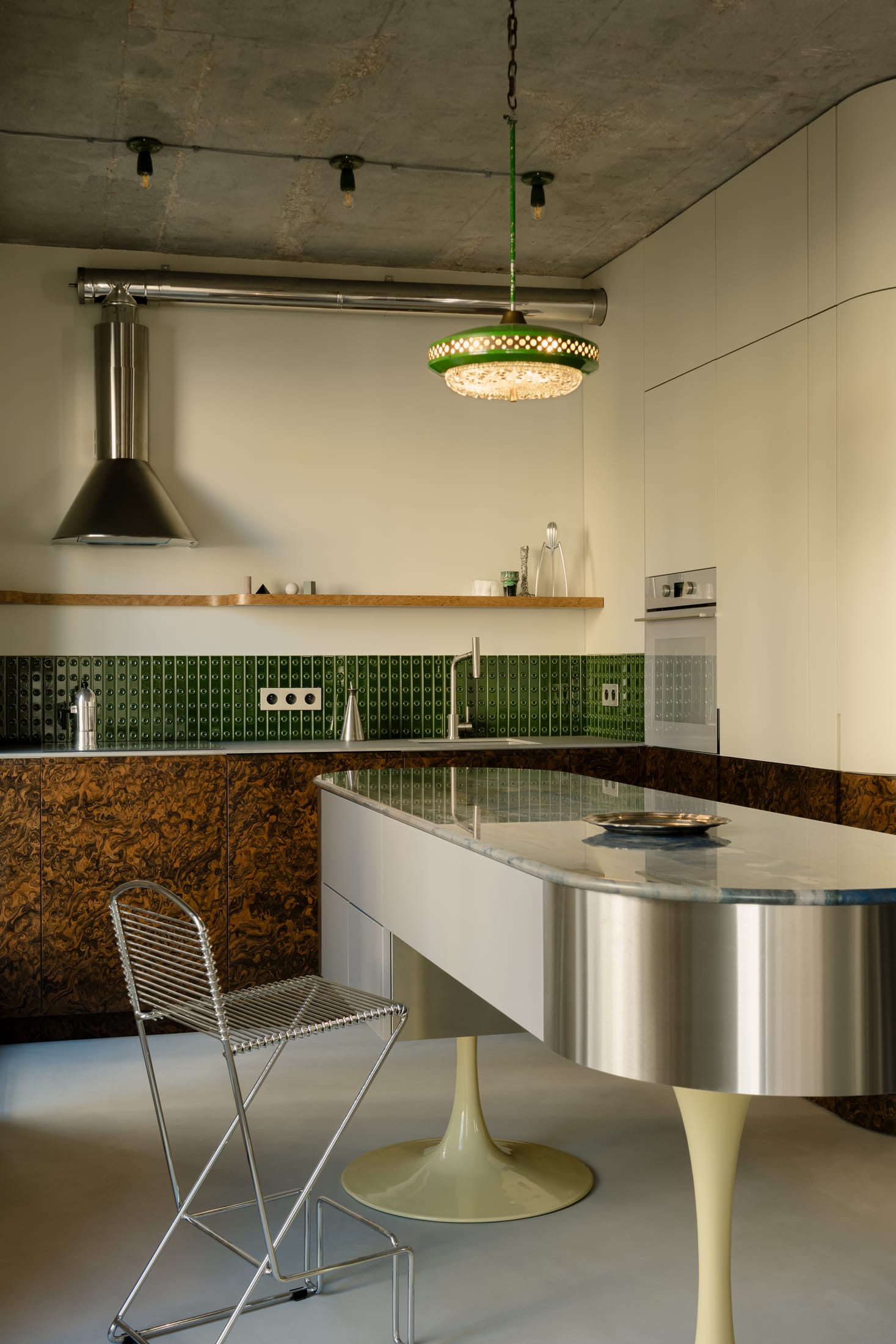
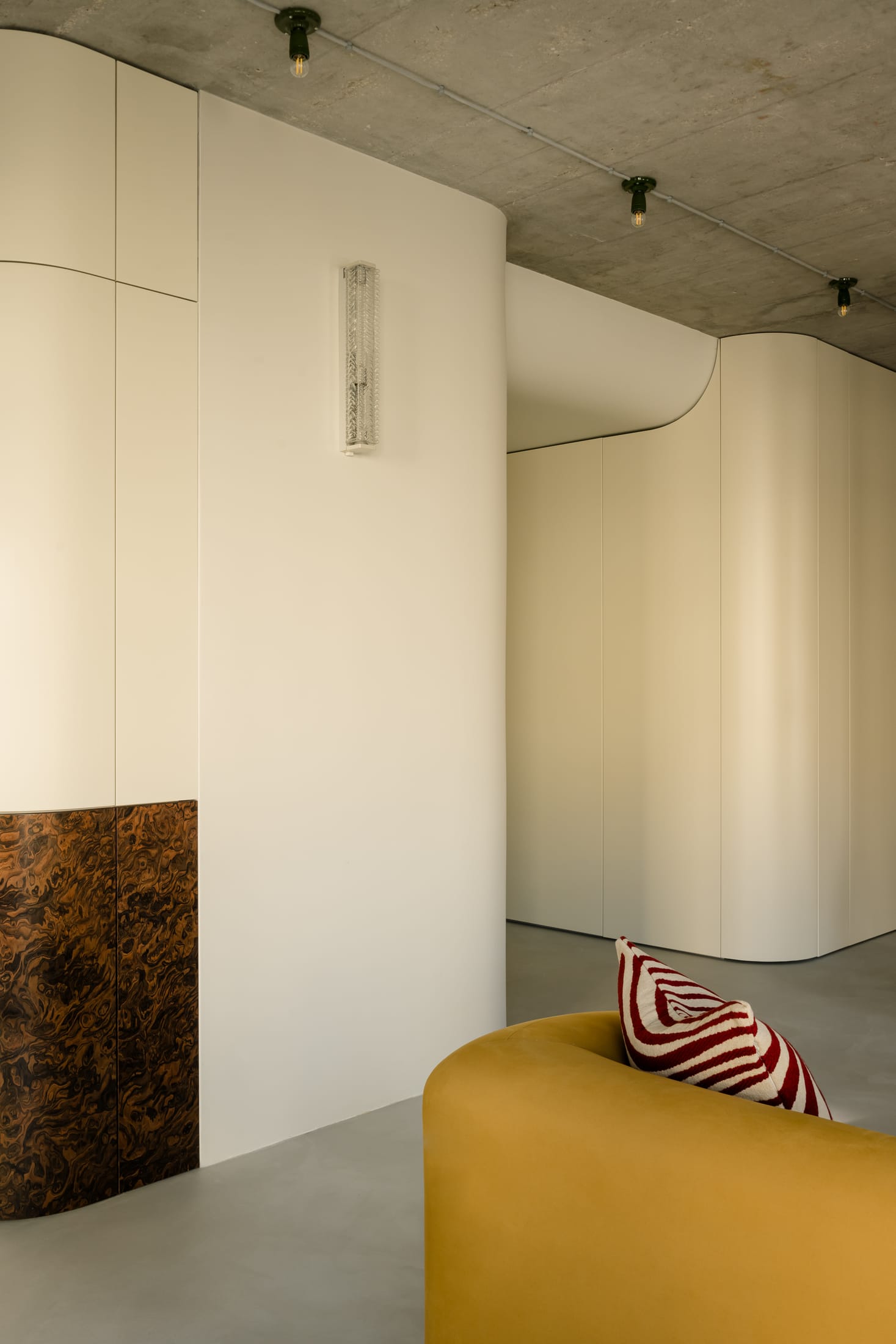
Once the "bones" of the apartment were exposed—including the original raw concrete ceilings which were left intentionally unfinished—the "maximalist" layering began. This is where Mistovia’s expertise in material juxtaposition shines. The palette is a sophisticated collision of textures: the cold, matte finish of concrete provides a foil for the warm, swirling patterns of high-end walnut burl wood and vibrant veneers.
The heart of this aesthetic narrative is the kitchen—or as I prefer to call it, the "Space-Age" culinary hub. Breaking away from the traditional "hidden" kitchen trend, Mistovia designed a bold, steel oval island. The island features striking yellow legs and is topped with a slab of rare blue quartzite. It functions as both a prep station and a social anchor, standing like a piece of functional sculpture against a backdrop of minimalist cabinetry.
Editor’s Tip: When mixing bold materials like blue quartzite and industrial steel, keep the surrounding "shell" neutral. The exposed concrete ceiling here acts as a visual stabilizer, preventing the vibrant colors from feeling overwhelming.
Beyond the fixed elements, the apartment is a playground for 20th-century design icons. The curation is meticulous, blending different eras of mid-century and contemporary design to create a home that feels evolved rather than "decorated."
- Dining Area: Features burgundy Verner Panton chairs that inject a dose of 1960s optimism.
- Seating: 1970s Mikado plywood pieces offer a geometric, architectural seating solution.
- Lighting: Minimalist tracks contrast with vintage-inspired sculptural lamps to define different functional zones within the open plan.
Private Sanctuaries: Texture and Color in Transition
While the living areas are defined by light and openness, the private quarters—the bedroom and bathrooms—offer a more intimate, tactile experience. The transition is marked by a shift in color temperature and material weight.
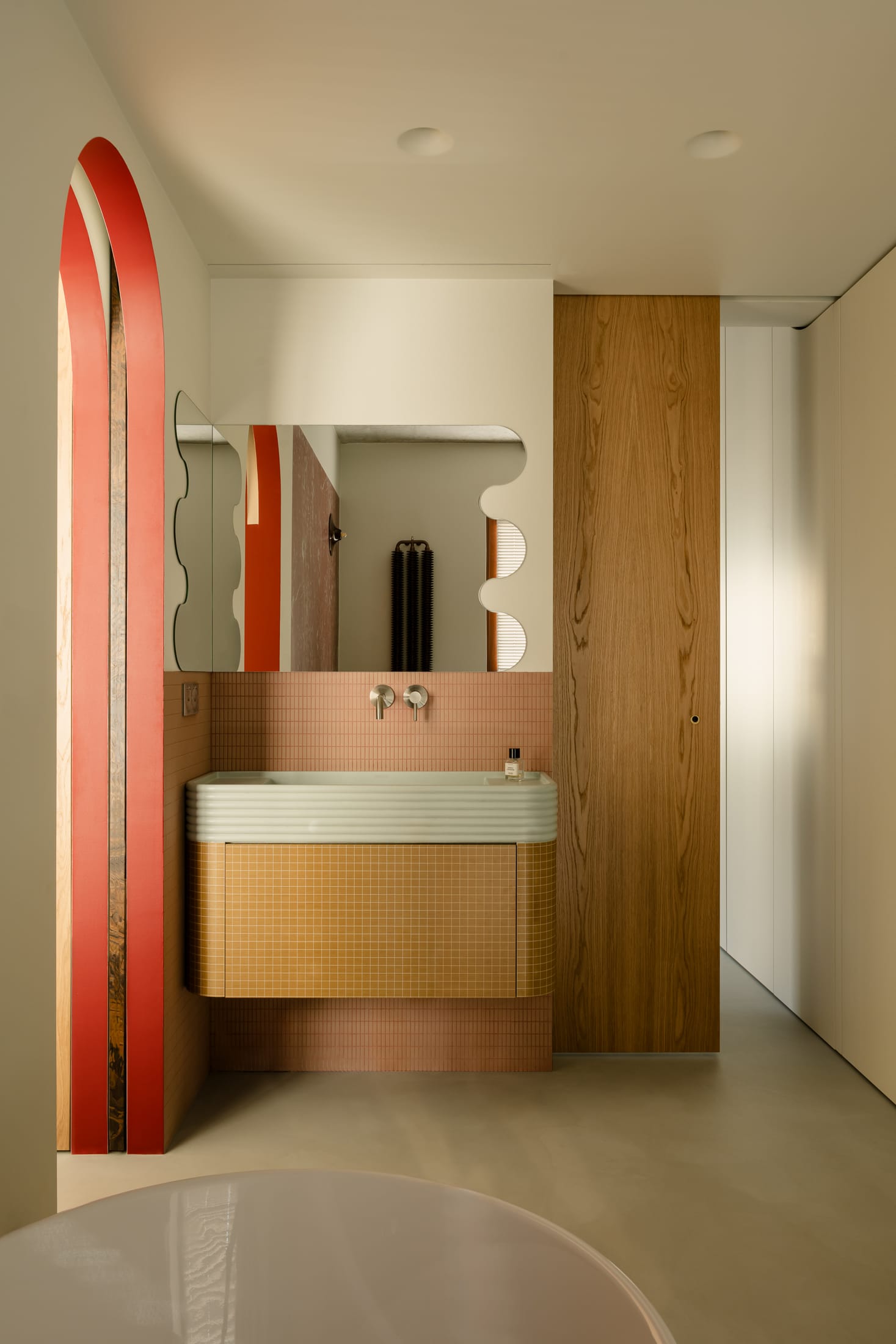
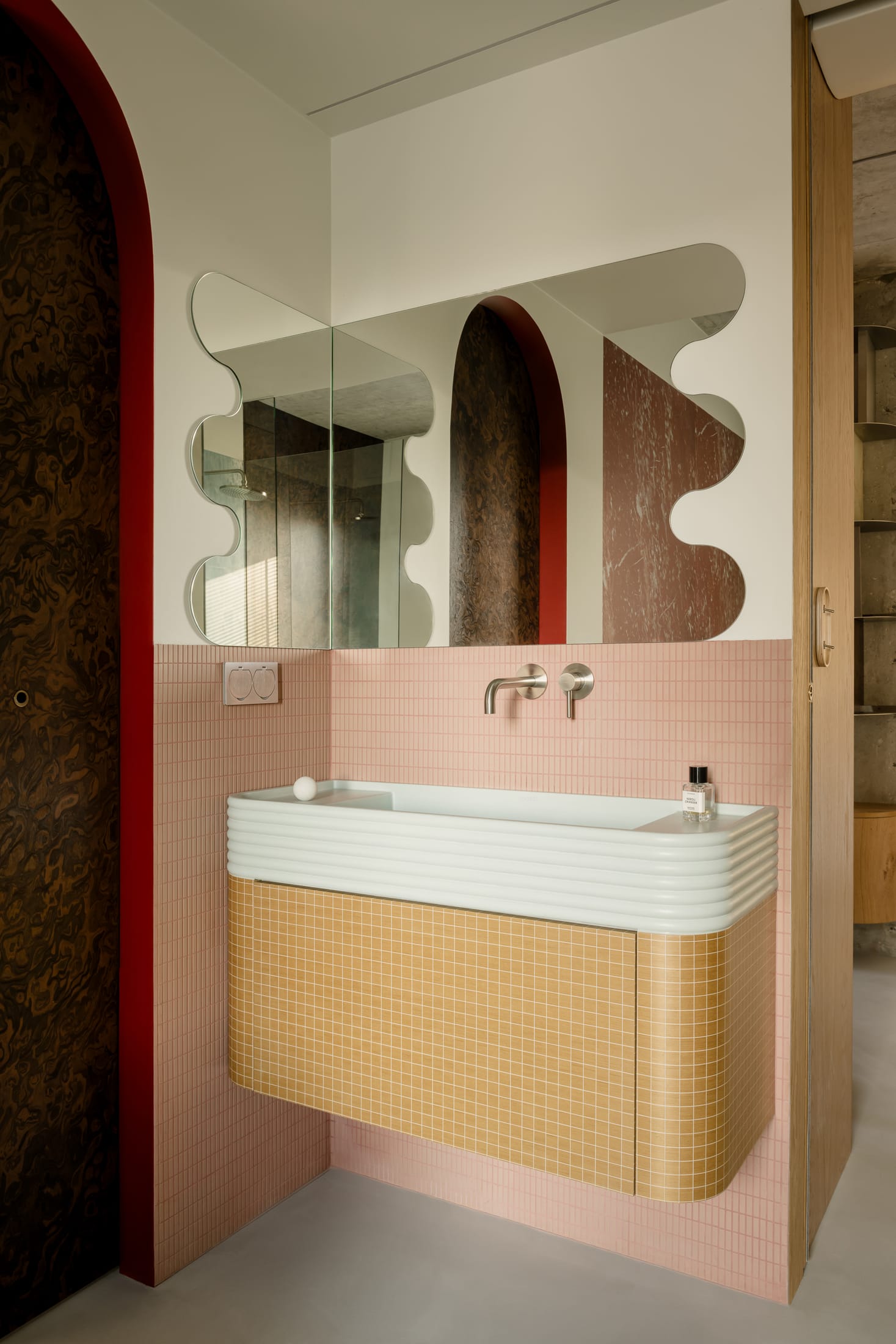
In the master bathroom, the design takes a dramatic turn toward the theatrical. Large-format Rosso Francia terracotta tiles, with their deep earthy reds and white veining, cover the walls. This is paired with delicate pink Bardelli mosaics, creating a high-contrast environment that feels like a modern Roman bath. The use of Mutina textured tiles adds another layer of "touchability," ensuring that even the most functional room in the house feels like a sensory experience.
The bedroom continues this "private sanctuary" theme but through the lens of a boutique mid-century hotel. Custom storage solutions in dark oak wrap around the room, providing ample utility while maintaining a sleek, uncluttered profile. The mood is intentionally darker and more grounded than the rest of the apartment, encouraging rest and reflection.
The Practical Reality of Renovating in Warsaw
For readers inspired by this Warsaw Praga project, it’s important to understand the logistics of such a high-end overhaul. Warsaw's property market is currently one of the most dynamic in Central Europe, and the demand for premium renovations is at an all-time high.
A project of this scale—removing 90% of walls and installing custom steel and stone—requires significant planning. Typically, a major structural overhaul in Warsaw takes between 1.5 to 3 months for the construction phase alone, not including the bespoke furniture fabrication.
Warsaw Renovation Cost Estimates (2024-2025)
| Service Level | Est. Cost per m2 (PLN) | Typical Finishes |
|---|---|---|
| Standard Renovation | 800 - 1,500 | Laminate floors, standard tiles, paint |
| Premium Design | 1,500 - 2,500 | Hardwood, designer tiles (Mutina), custom lighting |
| High-End Architectural | 3,000+ | Structural changes, stone (Quartzite), bespoke steel |
Material Palette Checklist: The Mistovia Look
If you're looking to replicate this "minimalist-maximalist" vibe, focus on these four pillars:
- Industrial Foundation: Leave a concrete beam or ceiling exposed to ground the space.
- Luxurious Veneers: Use walnut or oak burl for cabinetry to add organic, swirling patterns.
- Statement Stone: Don't settle for white marble; look for colorful quartzites or Rosso Francia terracotta.
- Glass Blocks: Use them as room dividers to maintain a 1980s-meets-modern-loft aesthetic.
FAQ
Is it safe to remove 90% of interior walls in an older apartment? It depends entirely on whether the walls are load-bearing or partition walls. In the Mistovia project, the majority were non-load-bearing partitions. Any structural overhaul must be preceded by a consultation with a structural engineer to identify the "unmovable" reinforced concrete elements.
How do I balance such bold colors like yellow and blue without it looking "messy"? The key is the "60-30-10" rule, but with a twist. Use a neutral industrial base (concrete/grey) for 60% of the space, a consistent wood tone for 30%, and save the bold primary colors (like the yellow island legs) for the final 10% as accents.
Why is Warsaw's Praga district becoming so popular for design? Praga escaped much of the destruction of WWII, leaving it with a wealth of original pre-war and industrial architecture. This "authentic" grit, combined with lower entry prices than the city center and a surge in new galleries and cafes, has made it the primary destination for creative renovations.
Whether you are planning your own structural overhaul or simply looking to inject a bit of "space-age" maximalism into your home, the Warsaw Praga apartment serves as a powerful reminder: design shouldn't just be functional—it should be a conversation. By embracing the raw and the refined simultaneously, Mistovia Studio has created a home that is truly one of a kind.