Quick Facts
- Location: Villa Fiorelli district, Rome, Italy
- Project Name: Casa Polly
- Architects: Marco Rulli and Thomas Grossi of 02A Studio
- Size: 1,292 square feet (120 square meters)
- Design Philosophy: A playful dialogue between 1960s Brutalist "bones" and high-energy Pop Art aesthetics
- Owners: Actress Martina Pinto and director Alessandro Poggi
Rome is a city defined by its layers. Usually, we talk about those layers in terms of centuries—Baroque churches built over Renaissance foundations, which in turn sit atop Roman ruins. But in the Villa Fiorelli district, a different kind of layering is taking place. Here, the architectural conversation is between the raw, structural honesty of the 1960s and the vibrant, expressive joy of modern living.
When actress Martina Pinto and director Alessandro Poggi moved into a 1,292-square-foot apartment originally designed by Valerio Ciampicacigli, they didn’t want a museum piece. They wanted a home that felt like a set for their lives—vibrant, functional, and deeply personal. Enter 02A Studio, whose renovation of "Casa Polly" has become a masterclass in how to reimagine Brutalism for the 21st century.
What is Casa Polly?
Casa Polly is a 1,292-square-foot apartment renovation in Rome's Villa Fiorelli district that harmoniously blends 1960s Brutalist structural elements with vibrant Pop Art aesthetics. Designed by 02A Studio architects Marco Rulli and Thomas Grossi, the project serves as a family home that balances monolithic architectural forms with a whimsical, "cartoonish" charm.
The renovation honors the apartment’s heritage while pivoting away from the coldness often associated with mid-century concrete. By preserving the original designer's intent and layering it with contemporary needs, 02A Studio has created a space where architectural tension becomes a source of domestic comfort.
The Brutalist Core: Celebrating Raw Materials
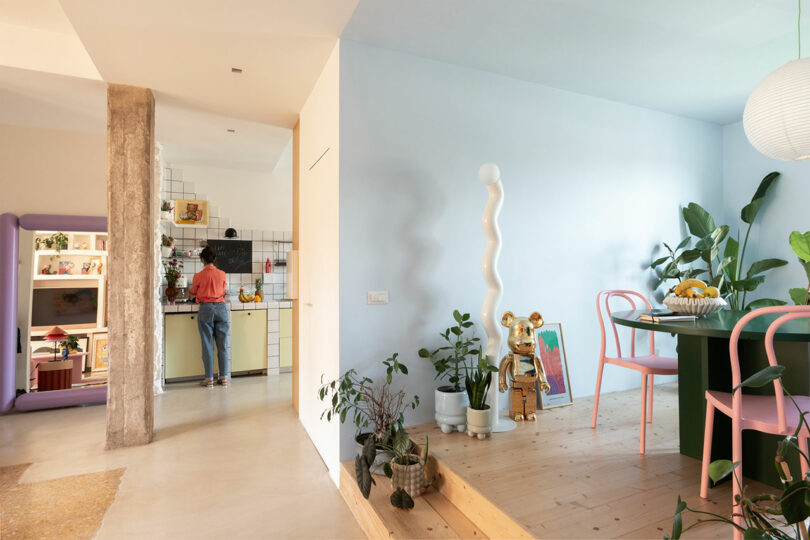
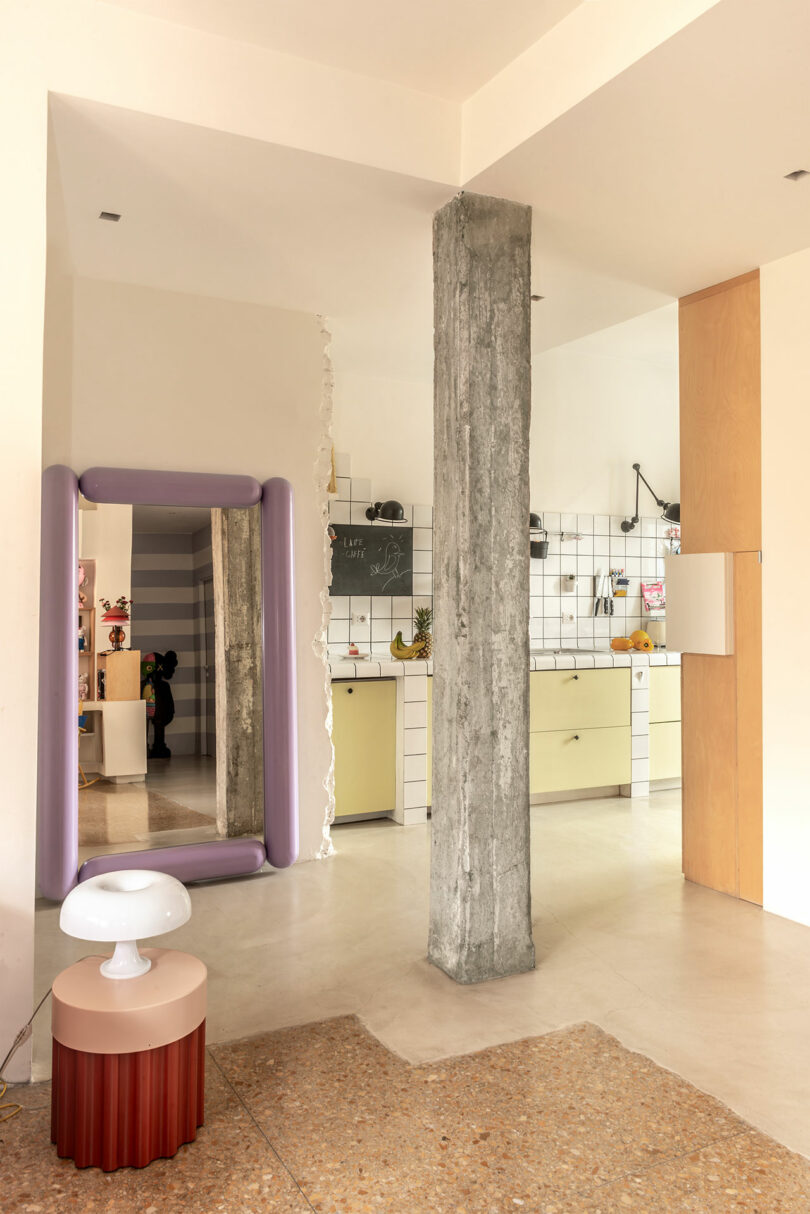
At the heart of Casa Polly lies a celebration of "Béton Brut"—raw concrete. In many renovations, structural pillars are hidden behind drywall, treated as obstacles to be disguised. Marco Rulli and Thomas Grossi took the opposite approach. They stripped back the layers to reveal a central exposed concrete pillar, allowing it to stand as a monolithic sculpture in the center of the living area.
However, Brutalism in a residential context requires a delicate touch. To prevent the space from feeling subterranean or harsh, the architects focused on light reflection and material durability. While traditional concrete is porous and heavy, 02A Studio utilized a resin finish over the original terrazzo flooring. This choice preserved the vintage soul of the home while providing a seamless, high-gloss surface that bounces light into every corner.
The 1,292-square-foot renovation successfully transformed the mid-century layout into a series of high-utility zones. By using resin and glossy kitchen tiles, the designers enhanced the apartment's natural luminosity, proving that Brutalist "bones" don't have to mean dark rooms.
Infusing Pop Art: Color, Pattern, and Play
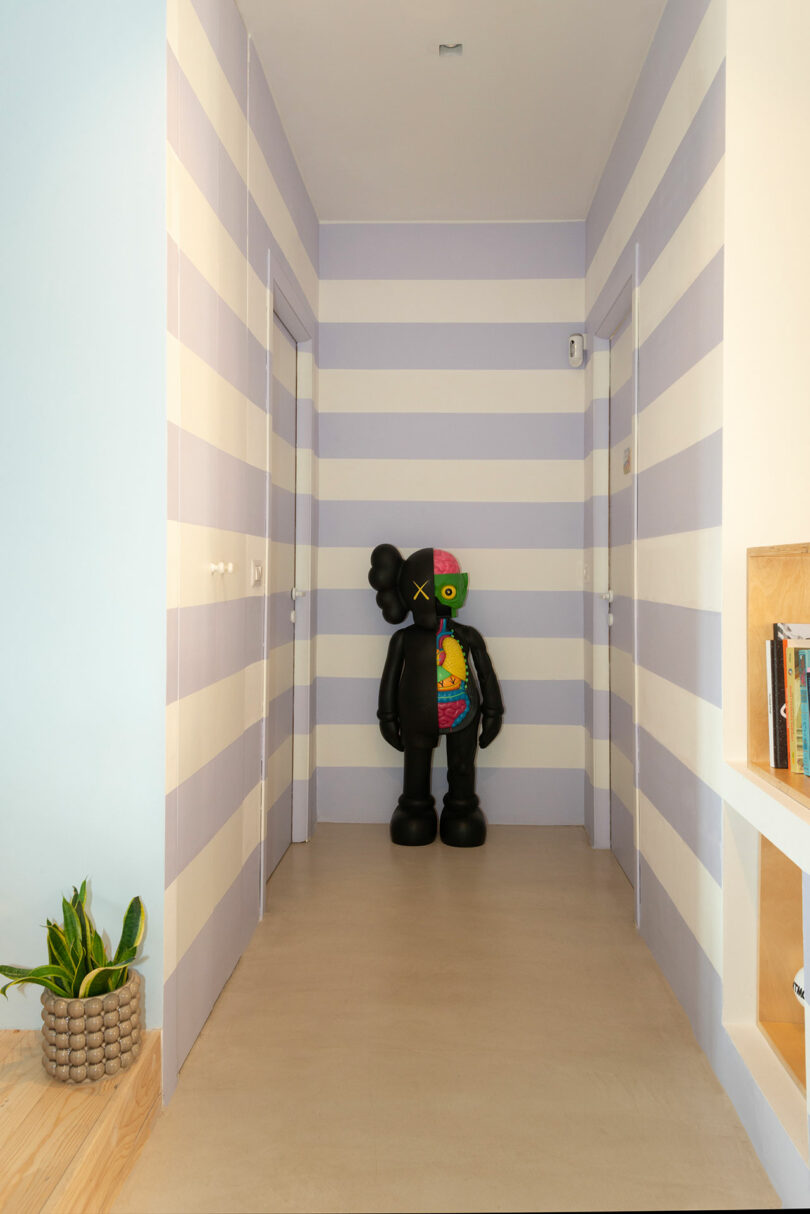
If the concrete pillar is the "anchor" of Casa Polly, the Pop Art elements are its "wings." The transition from the social areas to the private quarters is marked by a bold use of color and pattern. Nowhere is this more evident than in the "hallway hacking" strategy employed by the architects.
The hallway is often a wasted space in older apartments, but here it has been transformed into a gallery and a hidden storage powerhouse. Behind lilac-striped art walls, the team successfully integrated high-utility zones like a walk-in closet and a dedicated laundry area. This allowed the 1,292-sq-ft floor plan to remain open and airy without sacrificing the practical needs of a growing family.
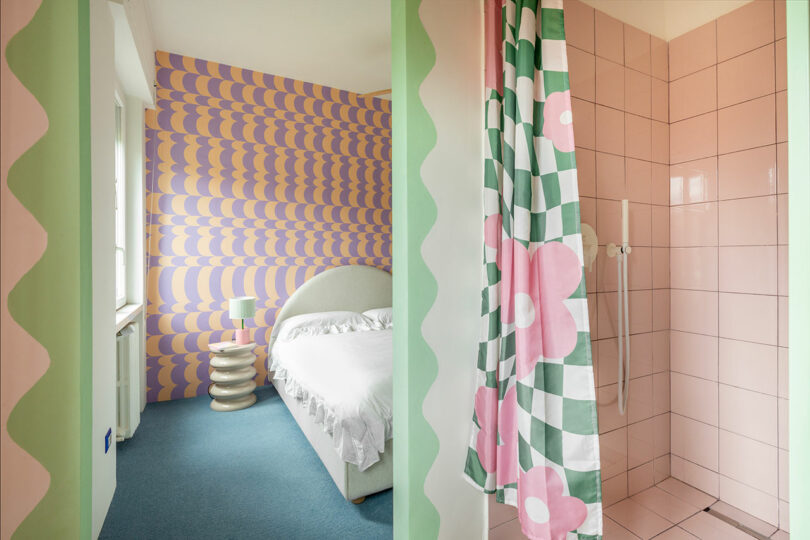
The "cartoonish" aesthetic continues into the bedrooms. By utilizing light blue carpets and flowing, organic lines, the architects softened the industrial edges of the building. It’s a design choice that Rulli describes as creating a "dreamy" atmosphere—a stark contrast to the rigid geometry of the 1960s structure.
Room-by-Room Design Highlights
The Open-Plan Living & Kitchen
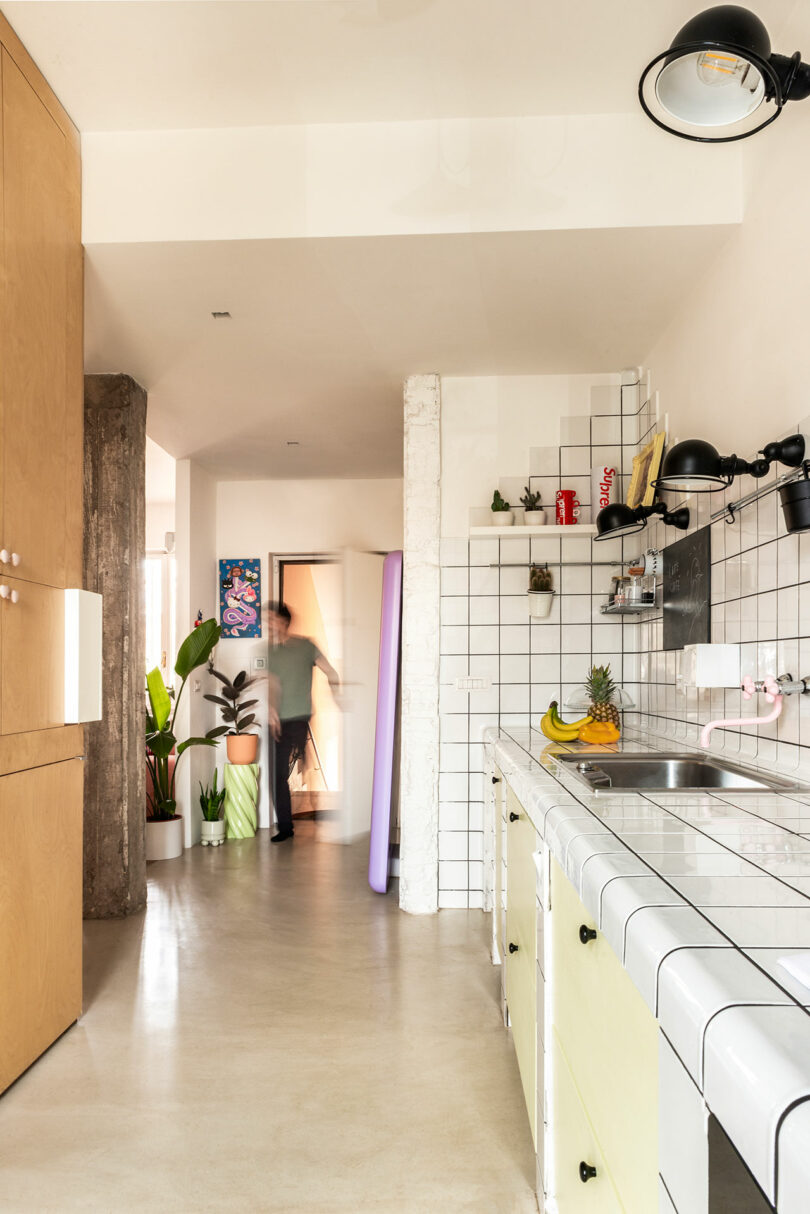
The living area is a study in texture. You have the raw, tactile grit of the concrete column standing against a kitchen that feels almost edible in its vibrancy. The kitchen features glossy white tiles and saturated yellow cabinetry, creating a high-contrast environment that feels energetic and modern.
To bridge these two worlds, 02A Studio used warm wood platforms to define different zones within the open plan. This "nesting" technique allows the family to feel cozy in a space that could otherwise feel too vast. The furniture selection—featuring green swivel chairs and a pink dining table—further cements the Pop Art influence, treating every piece of furniture as a character in a play.
The Pastel Sanctuary: Bathroom & Bedroom
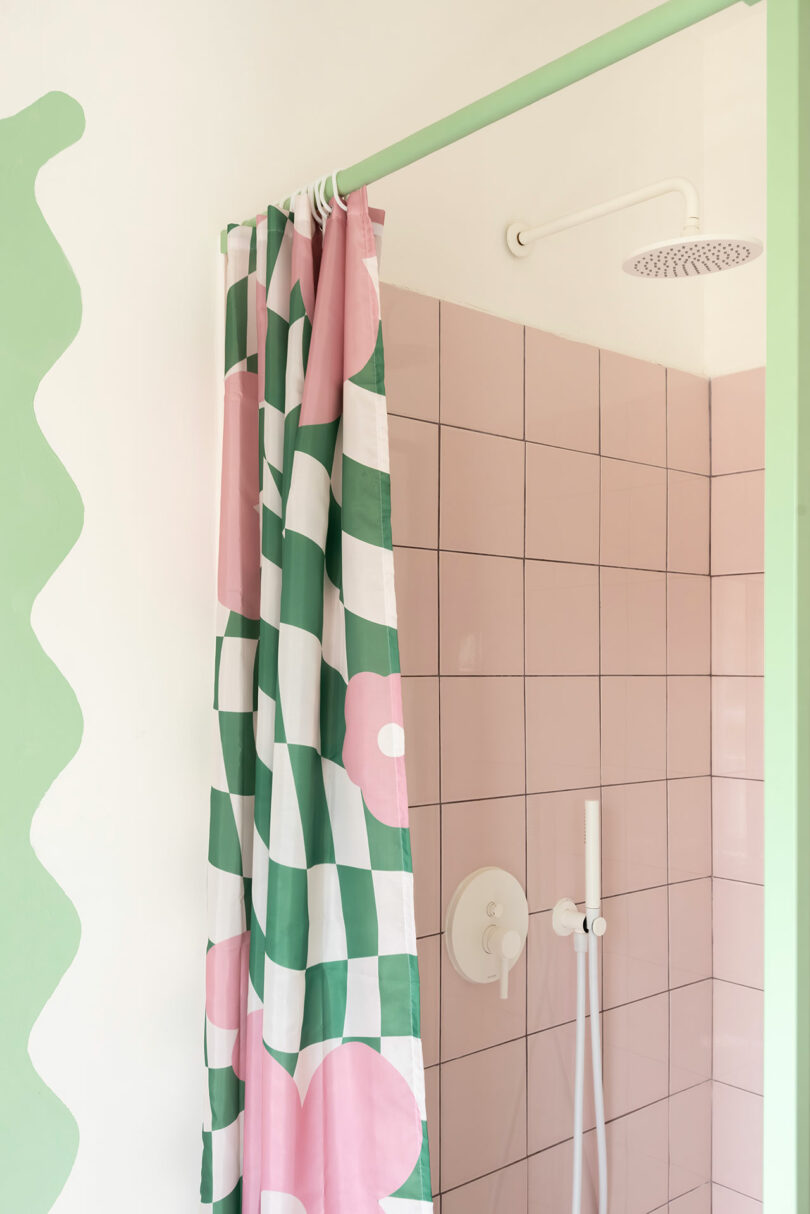
Moving into the private zones, the "wavy" motif takes center stage. Doorways are framed with green scalloped borders, a whimsical detail that makes the act of moving from room to room feel like stepping through a storybook.
The palette shifts here toward the "Pastel Sanctuary" look. Light blue, pale yellow, and soft pinks dominate, creating a soothing environment that is nonetheless full of personality. This is where the "softening" of Brutalism reaches its peak—the hard angles of the 1960s architecture are completely enveloped in a soft, color-block embrace.
Practical Tips: How to Soften Brutalism in Your Own Home
As an editor, I often hear from readers who love the "cool" factor of concrete and industrial lofts but fear they will feel too cold to live in. Casa Polly offers a blueprint for how to get this balance right. Modern Brutalist design can be softened by integrating natural materials such as wood, using light blue or pastel color palettes, and incorporating curved furniture to contrast raw concrete.
If you’re looking to bring this look home, consider these steps:
- Layer Natural Textures: Use oak, walnut, or even light-toned plywood to add warmth to stone or concrete surfaces.
- Embrace the Curve: In a space defined by straight lines and right angles, a curved sofa or a scalloped doorway (like the ones in Casa Polly) breaks the visual tension.
- Lighting as Sculpture: Don't settle for standard overheads. Use integrated LED strips to highlight architectural geometry and oversized, playful pendants to serve as focal points.
- Color Zoning: Use bold colors to define functional areas within an open plan. A "pop" of yellow in a kitchen can make an industrial space feel like a sunlit sanctuary.
The 02A Studio Approach: Architecture as Storytelling
For Marco Rulli and Thomas Grossi, every project is a puzzle. In the case of Casa Polly, the puzzle was how to respect the legacy of Valerio Ciampicacigli while making the space feel like it belonged to Martina and Alessandro.
The studio’s approach is rooted in "Honest Architecture"—the idea that materials should speak for themselves. By 2026, we expect to see a massive shift toward these "permanent" materials. In a world of fast furniture and temporary fixes, the return of Brutalist elements represents a desire for something that lasts. However, as Casa Polly proves, "permanent" doesn't have to mean "serious."
Through their clever use of resin, light-reflecting surfaces, and playful geometry, 02A Studio has turned a 1960s relic into a 2024 icon. It’s a home that celebrates where it came from while being unapologetically excited about where it’s going.
FAQ
Q: Is Brutalism a practical choice for a family home? A: Yes, if approached like 02A Studio did. By sealing porous concrete and using resin finishes on floors, you maintain the aesthetic while creating a surface that is easy to clean and durable enough for kids and pets.
Q: How do I choose colors to pair with raw concrete? A: High-contrast "primary" pops (yellow, red, blue) create a high-energy Pop Art feel. If you want something more serene, opt for "dusty" pastels like sage green or terracotta, which complement the gray tones of concrete beautifully.
Q: Can I achieve the Casa Polly look in a smaller apartment? A: Absolutely. The key is "visual flow." In Casa Polly's 1,292-sq-ft layout, they used consistent flooring and hidden storage to keep the space from feeling cluttered. The use of mirrors and glossy tiles can also make a smaller footprint feel significantly larger.