Quick Facts
- Location: Carabanchel, Madrid, Spain
- Size: 64 Square Meters (approx. 688 sq. ft.)
- Design Firm: OOIIO Architecture
- Concept: "The Total Reset"—gutting the interior to maximize flow and light.
- Key Result: 100% increase in natural light penetration and a 77% reduction in occupancy density.
- Aesthetic: Three-dimensional material collage using bold colors and sculptural storage.
Imagine a space designed for nine people. Now, take that same 64-square-meter footprint and reimagine it for just two. This is the story of House 64, a breathtaking transformation in Madrid’s Carabanchel district that defies the traditional constraints of "small-space living." When we talk about maximizing a 64sqm space, we often think of clever folding chairs or hidden beds. But for OOIIO Architecture, the solution wasn't just about furniture—it was about a complete architectural "Total Reset." By stripping the apartment back to its bare bones and treating the interior as a fluid landscape rather than a series of boxes, they created a home that feels exponentially larger than its measurements suggest.
The Evolution of Space: From 1960s Cramped to 2024 Fluid
The building itself dates back to the 1960s, a time when Madrid’s housing focused on maximum occupancy. This specific unit once housed a family of nine, carved into a labyrinth of tiny, dark rooms and narrow corridors. It was the antithesis of modern living. The first step in this small apartment renovation was a radical one: gutting the interior entirely.
The designers realized that to make a 64sqm apartment feel huge, they had to move away from the "room-by-room" mindset. By removing every non-structural partition, they achieved a 77% reduction in occupancy density. Instead of nine people navigating a maze, two people now enjoy a continuous, flowing environment. This "Total Reset" allowed the architects to treat the floor plan as a blank canvas, focusing on the quality of the void rather than the number of enclosures.
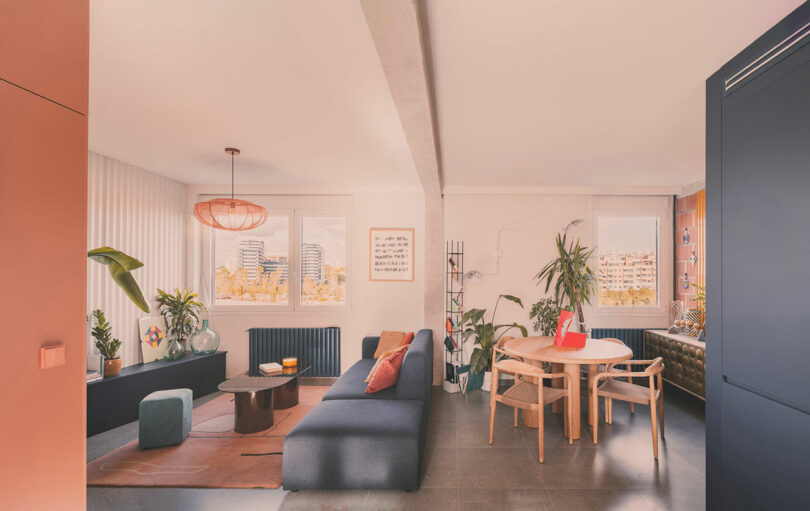
The Architectural Total Reset: Maximizing Light and Air
In a standard apartment, light is often the first casualty of traditional walls. In House 64, the "Total Reset" approach was specifically designed to connect the parallel facades of the building. By clearing the path from one side of the house to the other, the renovation achieved a staggering 100% increase in natural light penetration. Sunlight no longer dies in a hallway; it travels the full depth of the home.
Beyond just the visual impact, this layout facilitates cross-ventilation—a luxury often missing in small urban dwellings. In the height of a Madrid summer, the ability for air to flow freely between windows is a game-changer for comfort. The space doesn't just look bigger; it feels fresher and more expansive because it breathes.
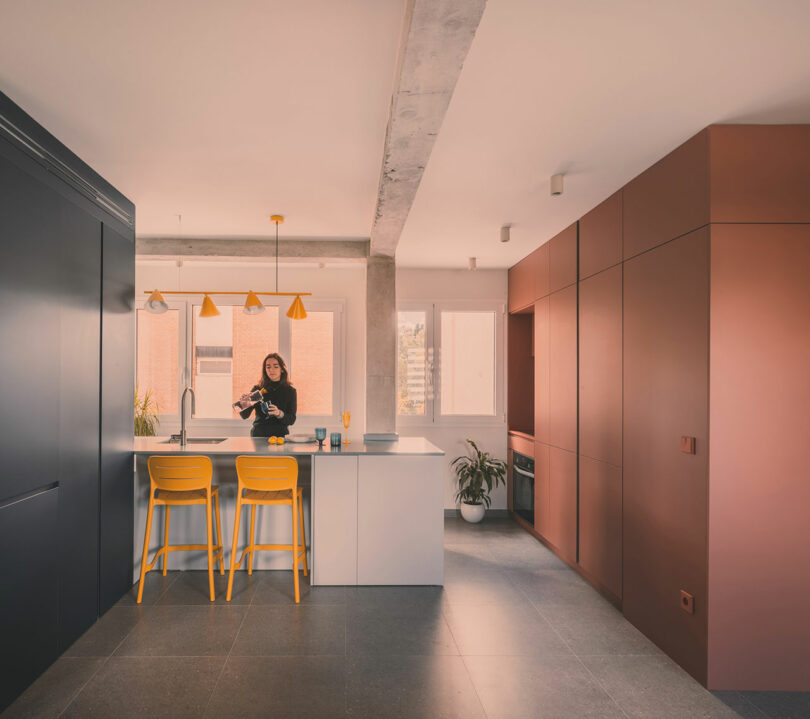
Sculptural Storage: Replacing Walls with Purpose
One of the most innovative features of the Madrid apartment transformation is how it defines "rooms" without using walls. Instead of drywall, House 64 utilizes sculptural storage units as three-dimensional dividers. These aren't just closets; they are architectural insertions that guide your movement through the home.
"A wall only blocks; a storage unit provides. By replacing partitions with cabinetry, every inch of the home’s vertical plane is put to work, serving both an aesthetic and a functional purpose." — Ivy Chen
The kitchen, for example, is defined by a deep blue block of cabinetry. It’s a bold, sculptural presence that signals a change in function without interrupting the line of sight. This strategy keeps the eye moving, which is the oldest trick in the book for making a small room feel larger. When you can see the ceiling and the floor continuing past a "divider," your brain perceives the entire volume of the house at once.
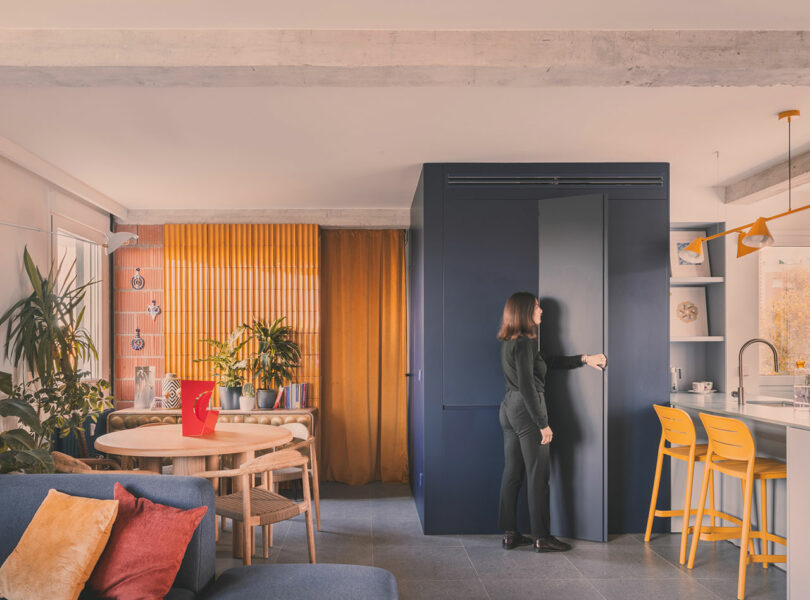
A Masterclass in Color Theory: Blue, Coral, and Gold
OOIIO Architecture didn’t shy away from color. In fact, they used it as a primary tool for maximizing 64sqm space. The palette is a "material collage" where textures and tones do the heavy lifting. Deep blue and coral are used strategically to define the kitchen and storage blocks, creating psychological boundaries that replace physical ones.
The use of color here is intentional and architectural:
- Deep Blue: Used for the kitchen cabinetry, it provides a sense of depth and stability, grounding the open-plan space.
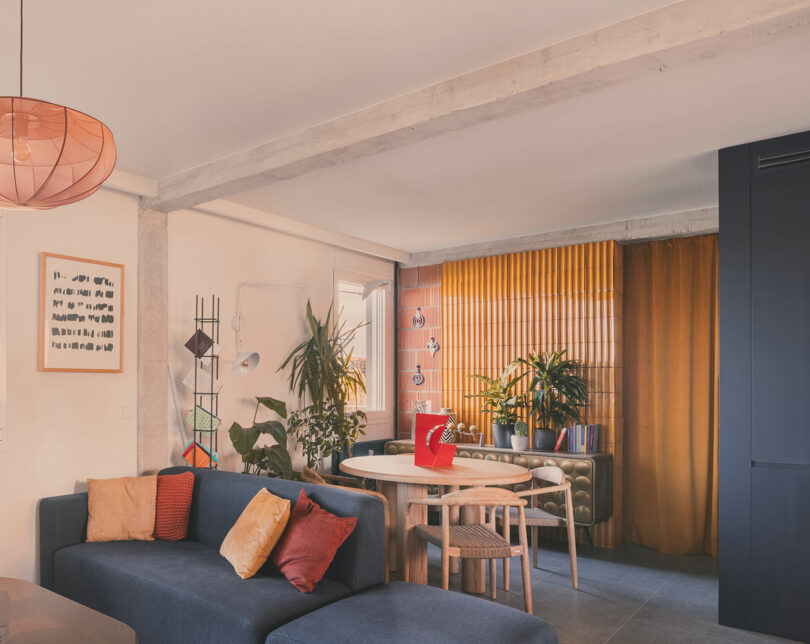
- Sunny Yellow: Found in the wavy tiles and golden velvet curtains, this adds a burst of "artificial sunlight" even on overcast days.
- Clay Tones: Terracotta-colored elements connect the interior to traditional Spanish aesthetics while remaining firmly modern.
This approach is beautifully complemented by curated furniture pieces. Brands like HAY and Kave Home were selected for their clean lines and "intentional surfaces." A slender dining chair or a low-profile sofa ensures that the furniture participates in the architecture rather than cluttering it.
5 Lessons from House 64 for Your Small Renovation
You don't need a team of Spanish architects to apply the principles of House 64 to your own home. Here are five actionable takeaways:
- Multipurpose Everything: If you are installing a divider, make sure it stores something. A bookshelf that acts as a room divider is twice as valuable as a wall.
- Vertical Utilization: Take your storage all the way to the ceiling. In House 64, the floor-to-ceiling sky-blue wardrobes offer massive storage while keeping the floor plan clear of clutter.
- The Mirror Effect: Strategic placement of reflective surfaces can double your perceived space. Use mirrors on walls opposite windows to bounce light into the darkest corners.
- Continuous Flooring: Use the same flooring material throughout the entire apartment (like the terrazzo used here). This prevents the "chopped up" feeling that different floorings create.
- Scale Your Furniture: Choose pieces with "visual weight" that matches your space. Legs on sofas and transparent materials (like glass or acrylic) allow the eye to see more of the floor, which trick the brain into thinking the room is bigger.
The Materiality of the Collage
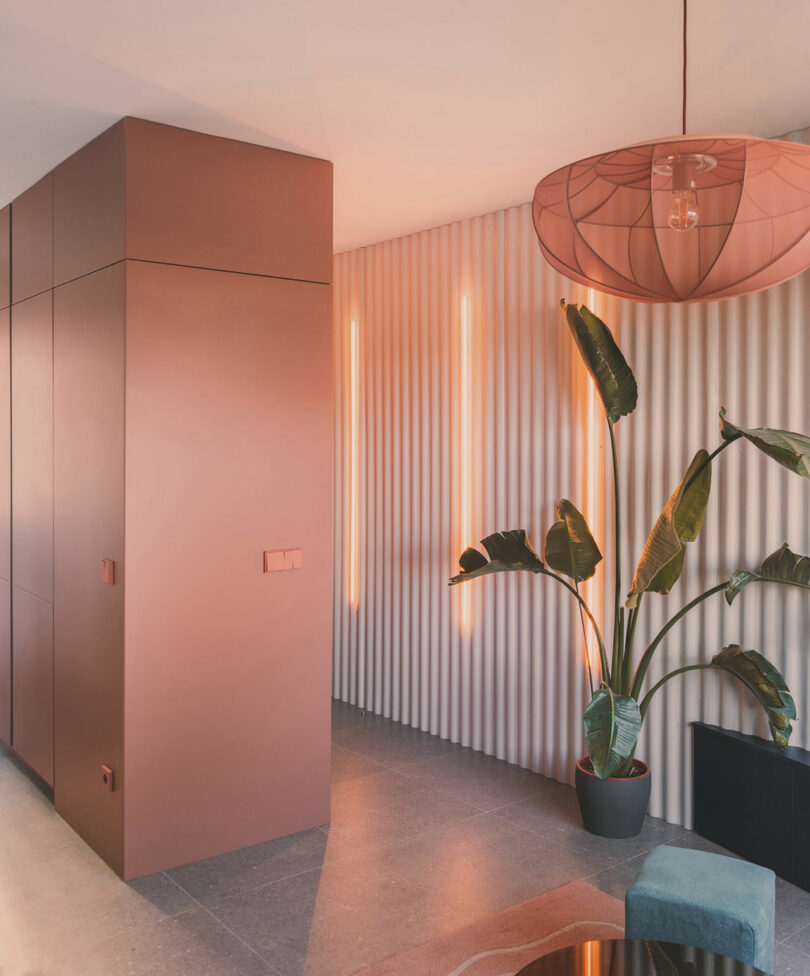
What makes OOIIO Architecture House 64 stand out is the texture. They didn't just use flat paint; they played with corrugated metal, wavy yellow tiles, and clay-toned ceramics. In a small space, tactile variety provides visual interest that prevents the room from feeling "boxed in." When every surface has a story—from the cold touch of metal to the warmth of velvet curtains—the home feels rich and layered rather than small and restrictive.
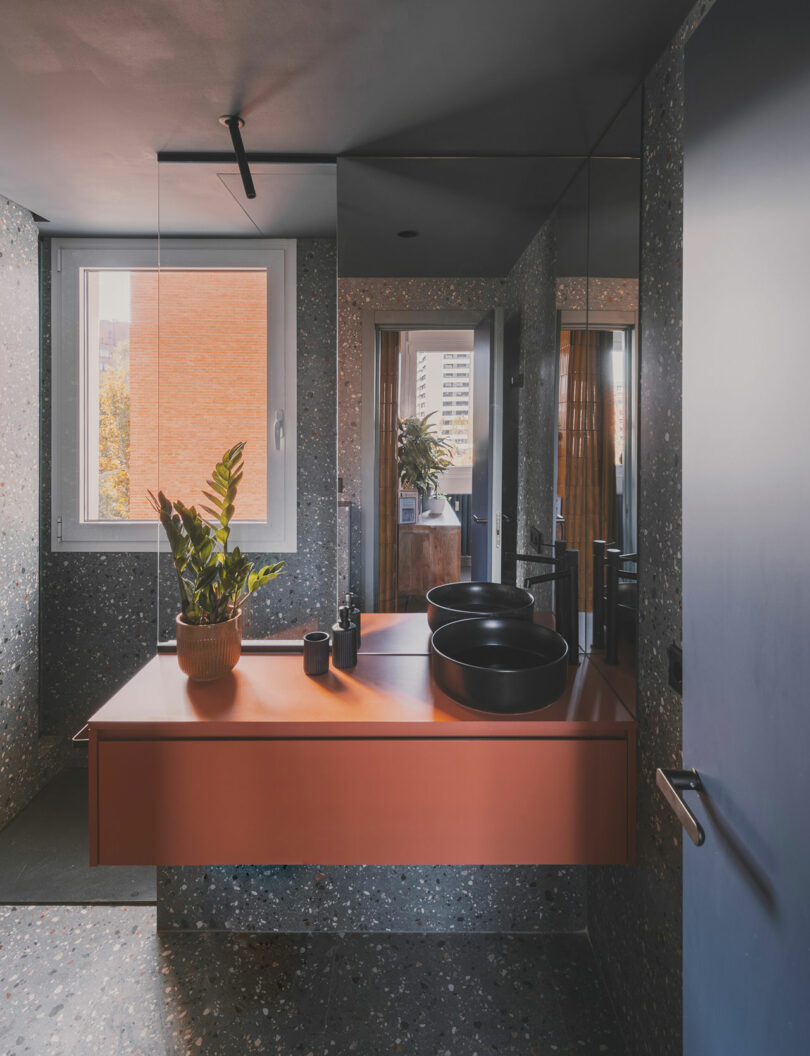
In the bathroom, the strategy continues. Instead of a cramped, tiled box, the space uses continuous materials and strategic mirrors to create an illusion of depth. It’s a reminder that even the smallest utility room can feel like a sanctuary with the right design choices.
Conclusion
House 64 is a masterclass in modern living. It proves that a 64 square meter house design doesn't have to be a compromise. By embracing the "Total Reset," prioritizing natural light, and using sculptural storage instead of walls, OOIIO Architecture has created a home that feels grand, fluid, and deeply personal. It’s a testament to the idea that luxury isn't about the number of square meters you have—it’s about how you use them.
FAQ
Why is a 64sqm apartment considered a 'modern luxury' for two? In urban centers like Madrid, space is the ultimate currency. A 64sqm home becomes a luxury when it is designed for quality of life rather than maximum occupancy. With fewer people and an open-plan layout, the apartment offers a sense of freedom, light, and air that is often missing in larger, poorly designed suburban homes.
What are the best materials for making a small room feel larger? Focus on light-reflecting or translucent materials. Polished concrete or terrazzo flooring creates a seamless look. Mirrors are essential. Additionally, using "airy" materials like perforated metal or glass partitions allows light to pass through while still defining separate areas.
How much does a 'total reset' renovation usually cost? A "total reset"—which involves gutting the interior, moving plumbing, and installing custom cabinetry—is a significant investment. Generally, you can expect to spend between $1,500 and $2,500 per square meter for a high-end architectural renovation, though this varies greatly by region and material choices.