Quick Facts
- Material Origin: High-quality rye straw is primarily sourced from Western Ukraine, prized for its length and natural luster.
- The "Glow" Secret: The iridescent finish is a result of the natural silica found in the straw's outer skin, which reflects light like a prism.
- Labor Intensive: Approximately 65% of the production time is dedicated solely to preparing the straw (cleaning, dyeing, and flattening).
- Precision Craftsmanship: A single bespoke tabletop can require the manual application of over 1,500 individual straw strips.
- Finish Preference: Artisans often choose a satin finish to highlight the depth of the straw without the distracting glare of high-gloss coatings.
In the world of luxury interior design, there is a quiet resurgence of a material so humble it was once known as "the poor man’s gold." Straw marquetry—the art of inlaying hand-dyed rye straw—has returned to the forefront of modern living spaces, offering a depth and movement that wood veneers simply cannot replicate. To the uninitiated, a piece of straw marquetry furniture looks like it has been crafted from liquid silk or polished metal. As you move around the room, the surface shifts, shimmering with a rhythmic luminosity that feels almost alive.
This mesmerizing effect, known as iridescence, is not achieved through synthetic paints or pearlescent additives. Instead, it utilizes the natural silica and reflective properties of the rye straw itself. When split, flattened, and hand-dyed, these humble stalks capture light from multiple angles, creating a kaleidoscopic finish that defines the pinnacle of contemporary artisan furniture.
The Raw Material: Why Western Ukraine Rye Straw?
Not all straw is created equal. While many grains produce stalks, the rye straw sourced from the fertile fields of Western Ukraine is widely considered the gold standard for high-end marquetry. The climate and soil conditions in this region produce straw that is exceptionally long, flexible, and—most importantly—rich in natural silica.
The silica acts as a glass-like coating on the outer layer of the stalk. When the straw is harvested, it is not merely "dried grass"; it is a biological gemstone. The harvesting process itself is an exercise in patience. The straw must be cut by hand to ensure the delicate stalks aren't crushed by heavy machinery.
Once harvested, the material is graded. Only the most pristine, unblemished stalks make it to the workshop. This obsession with material origin is what allows a designer to create a finish that remains vibrant for decades. Unlike synthetic materials that degrade over time, high-quality rye straw retains its structural integrity and reflective power, aging gracefully alongside the home it inhabits.
The Meticulous Preparation: 65% of the Labor
When we look at a finished sunburst cabinet or a shimmering coffee table, we are seeing the final 35% of the work. The true soul of straw marquetry lies in the preparation phase, a grueling and precise period that accounts for the vast majority of the labor time.
The preparation involves several critical stages:
- Cleaning and Sorting: Each stalk is cleaned to remove the inner pith and external debris.
- Hand-Dyeing: Unlike industrial dip-dyeing, artisan straw is hand-dyed in small batches. This ensures that the color penetrates the fibers while allowing for subtle tonal variations that add "soul" to the final piece.
- The "Cracking Sound" Test: Artisans listen for a specific sound when bending the straw. A sharp, clean crack indicates the perfect moisture content. If the straw is too damp, it will rot; if it's too dry, it will shatter during the flattening process.
- Flattening: This is where the magic happens. Using a bone folder or a specialized wooden tool, the artisan splits the round stalk and irons it flat. This transforms a three-dimensional tube into a flat, lustrous ribbon of fiber.
"In bespoke furniture production, the preparation of the raw material is where the artisan earns their stripes. It is a meditative, repetitive, and unforgiving process where a single mistake in the dyeing temperature can ruin an entire month's harvest."
The Artisan’s Technique: From Straw to Ribbon
Once the straw has been transformed into ribbons, the "inlay" process begins. This is where the furniture starts to take on its iridescent character. The artisan uses a veneer hammer and incredibly thin, surgical-grade knives to apply the strips to a substrate—usually high-quality MDF or solid wood.
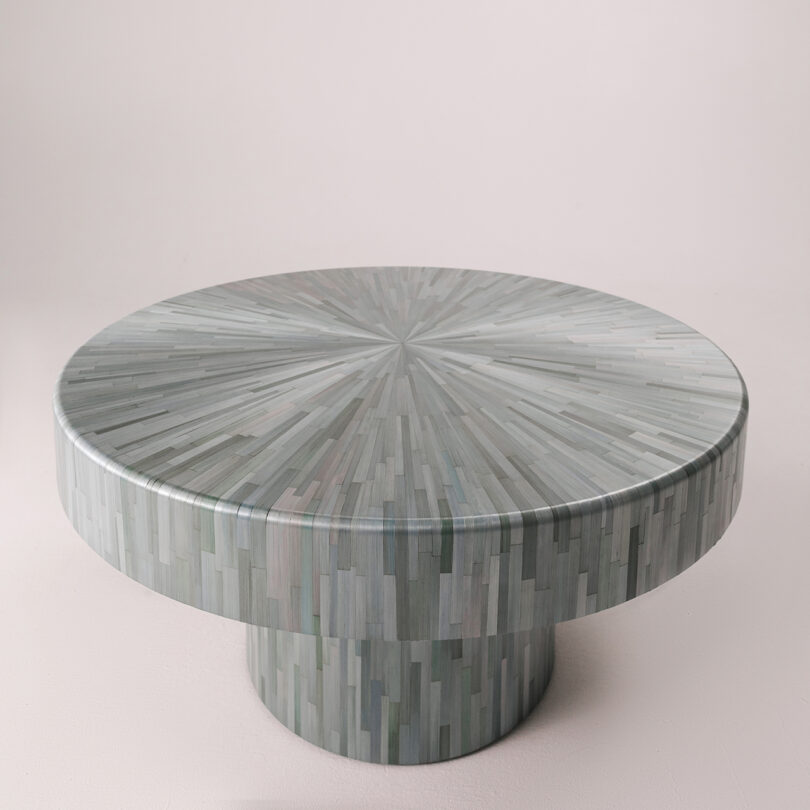
The complexity of the patterns is staggering. For a standard circular tabletop, an artisan might manually apply over 1,500 individual rye straw strips. Each strip must be perfectly butt-jointed against its neighbor. There is no room for wood filler or putty here; the perfection of the finish relies entirely on the precision of the cut.
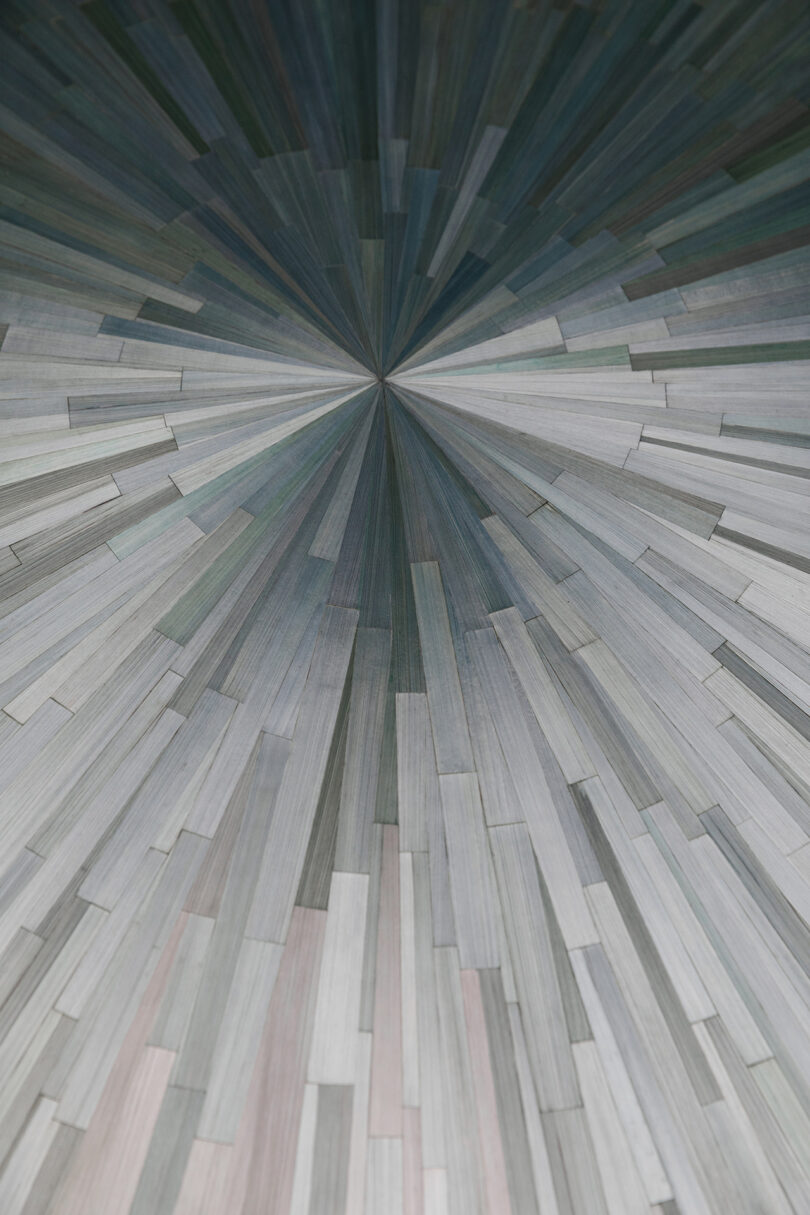
As the strips are laid down, usually in a radial or "sunburst" pattern, the direction of the fibers changes. Because each strip reflects light in a slightly different direction based on its orientation, the finished surface creates an optical illusion of movement. When you walk past the piece, the "shimmer" follows you.
Case Study: Katerina Bulgakova’s Seahorse Coffee Table
To understand the full potential of this medium, one must look at the work of Katerina Bulgakova. Her "Seahorse" collection is a masterclass in how straw marquetry can bridge the gap between organic nature and structured luxury.
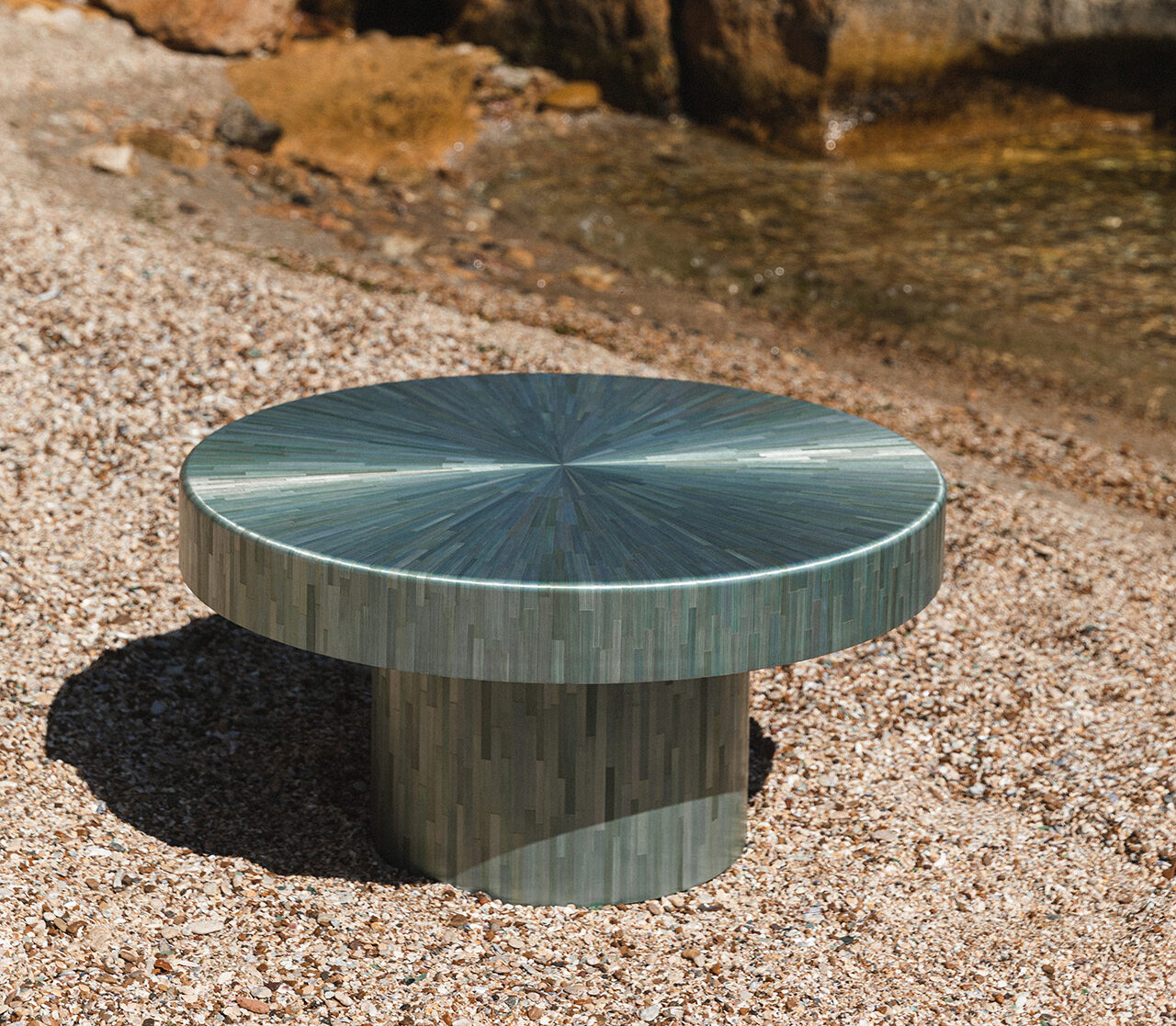
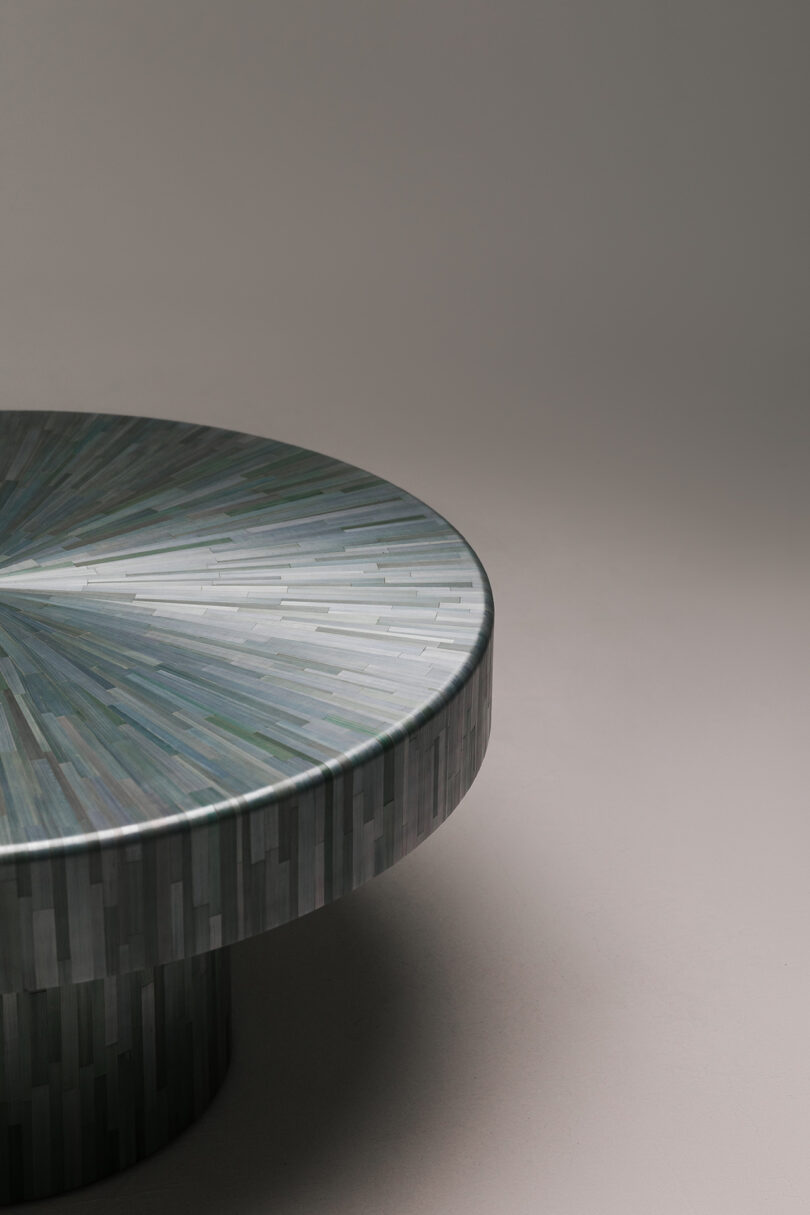
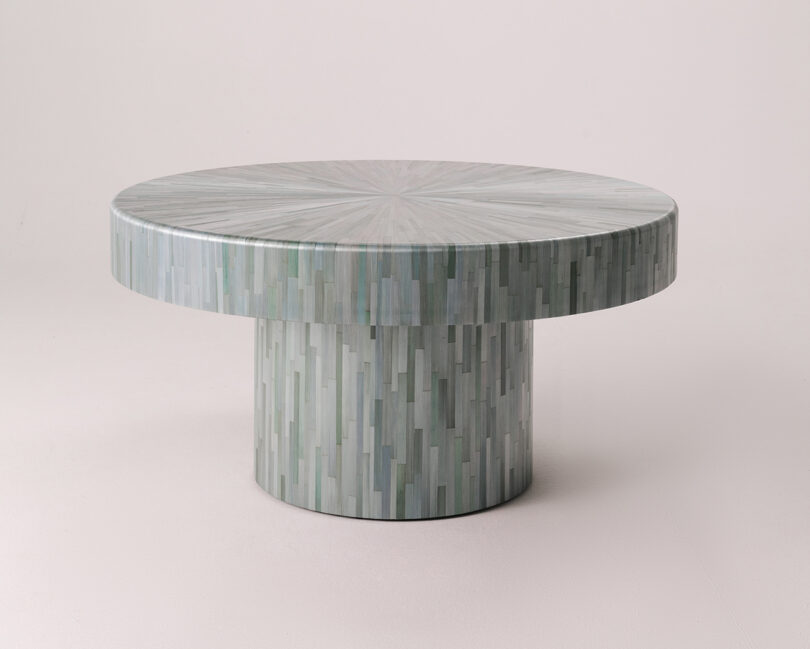
The Seahorse Coffee Table utilizes a complex radial symmetry. Instead of a simple sunburst, Bulgakova uses varying lengths and shades of hand-dyed straw to mimic the organic scales and textures found in marine life. The design philosophy here is "spatial poetry"—the table doesn't just fill a gap in the living room; it tells a story of light and water.
What makes this piece particularly impressive is the application of straw to the cylindrical base. Applying flat straw ribbons to a curved surface requires a level of tension control that only a master artisan possesses. The result is a piece that looks as though it was carved from a single, shimmering block of obsidian or deep-sea coral.
Choosing the Right Finish: Satin vs. High Gloss
The final step in creating iridescent furniture is the topcoat. While the straw itself is naturally shiny due to the silica, a protective finish is necessary to ensure longevity and ease of maintenance. The choice between satin and high gloss is a frequent debate among interior designers.
| Feature | Satin Finish | High Gloss Finish |
|---|---|---|
| Light Reflection | Diffused, soft, and "inner" glow | Sharp, mirror-like, and "outer" reflection |
| Color Depth | Enhances the natural grain and dye | Darkens the tones, creating a metallic look |
| Maintenance | Hides fingerprints and dust well | Requires frequent polishing to stay pristine |
| Best For | Modern, understated luxury | Bold, statement "glam" pieces |
For most high-end applications, a satin finish is preferred. It protects the straw without creating the harsh, "plastic" reflections that can sometimes obscure the intricate marquetry patterns. A satin coat allows the light to penetrate the straw fibers and bounce back, creating that signature "glow from within" that defines the medium.
FAQ: Caring for Your Straw Marquetry
What is the lifespan of straw marquetry furniture? When properly crafted and maintained, straw marquetry can last for generations. It is surprisingly durable because the silica in the straw is naturally resistant to moisture. However, like any fine wood furniture, it should be kept in a climate-controlled environment.
Can hand-dyed straw resist fading? Modern artisans use high-quality, UV-resistant dyes. While all natural materials will undergo some "patina" over decades of light exposure, quality straw marquetry is remarkably colorfast compared to traditional wood stains.
How do you clean iridescent straw finishes? Maintenance is simpler than you might think. A soft, dry microfiber cloth is usually all that’s needed. Avoid using harsh chemical sprays or excessive water, as these can seep between the joints of the straw strips over time.
Bringing the Shimmer Home
The allure of hand-dyed rye straw lies in its ability to transform a functional object into a piece of kinetic art. In an era of mass-produced, flat-packed furniture, straw marquetry reminds us of the value of the human touch. Whether it's a small decorative box or a grand dining table like those designed by Katerina Bulgakova, adding a piece of iridescent straw furniture to your home is an investment in both craftsmanship and light.
If you are looking to elevate your space with a material that feels both ancient and futuristic, look no further than the humble stalk of rye. It is, quite literally, nature’s most luminous gift to the interior world.